We have some exciting news to share! The Motley Fool UK has now become The Twelfth Magpie -- an independent, UK-owned company, led by our long-serving UK management team — Mark Rogers, Chris Nials and Heather Adlington. In practical terms, it’s the same team you know, now fully focused on serving our UK readers and members.

Just as importantly, our approach remains unchanged: long-term, jargon-free, and on your side. This site is our new home, and there will be extra tweaks made across the coming few days as we settle in. So if anything looks a little off, please bear with us!

If you had maxed your ISA for 20 years, here’s the passive income it could now generate

Andrew Mackie asks what 20 years of ISA investing could be worth — and why consistency matters more than contribution size.

| More on:
View over Old Man Of Storr, Isle Of Skye, Scotland

Image source: Getty Images

You’re reading a free article with opinions that may differ from The Twelfth Magpie’s Premium Investing Services. Become a member today to get instant access to our top analyst recommendations, in-depth research, investing resources, and more. Learn more, and get a free 'Best Buy Now' stock!.

Maxing out a Stocks and Shares ISA every year for 20 years would build a substantial portfolio.

But the more important lesson for investors is that the same principle applies even to much smaller contributions. What matters most is consistency over time.

Should you buy Halma Plc shares today?

Before you decide, please take a moment to review this report first. Despite ongoing uncertainties from US tariffs to global conflicts, Mark Rogers and his team believe many UK shares still trade at substantial discounts, offering savvy investors plenty of potential opportunities to learn about.

That’s why this could be an ideal time to secure this valuable research – Mark’s analysts have scoured the markets to reveal 5 of his favourite long-term ‘Buys’. Please, don’t make any big decisions before seeing them.

It’s not the starting amount that drives the outcome, but the combination of time and compounding.

So what could a consistently funded ISA actually become after 20 years?

Time in the market

The chart below shows the outcome of consistently investing into a Stocks and Shares ISA over 20 years, assuming different annual return profiles: 5% (balanced), 7% (equities), and 10% (strong equity markets).

In all three scenarios, the total amount invested is the same — £400,000 over 20 years. The difference in outcomes comes entirely from returns and compounding.

What stands out is how powerful that compounding effect becomes over time. At 7% and 10% returns, more than 50% of the final portfolio value is generated not from contributions, but from investment growth on previous gains.
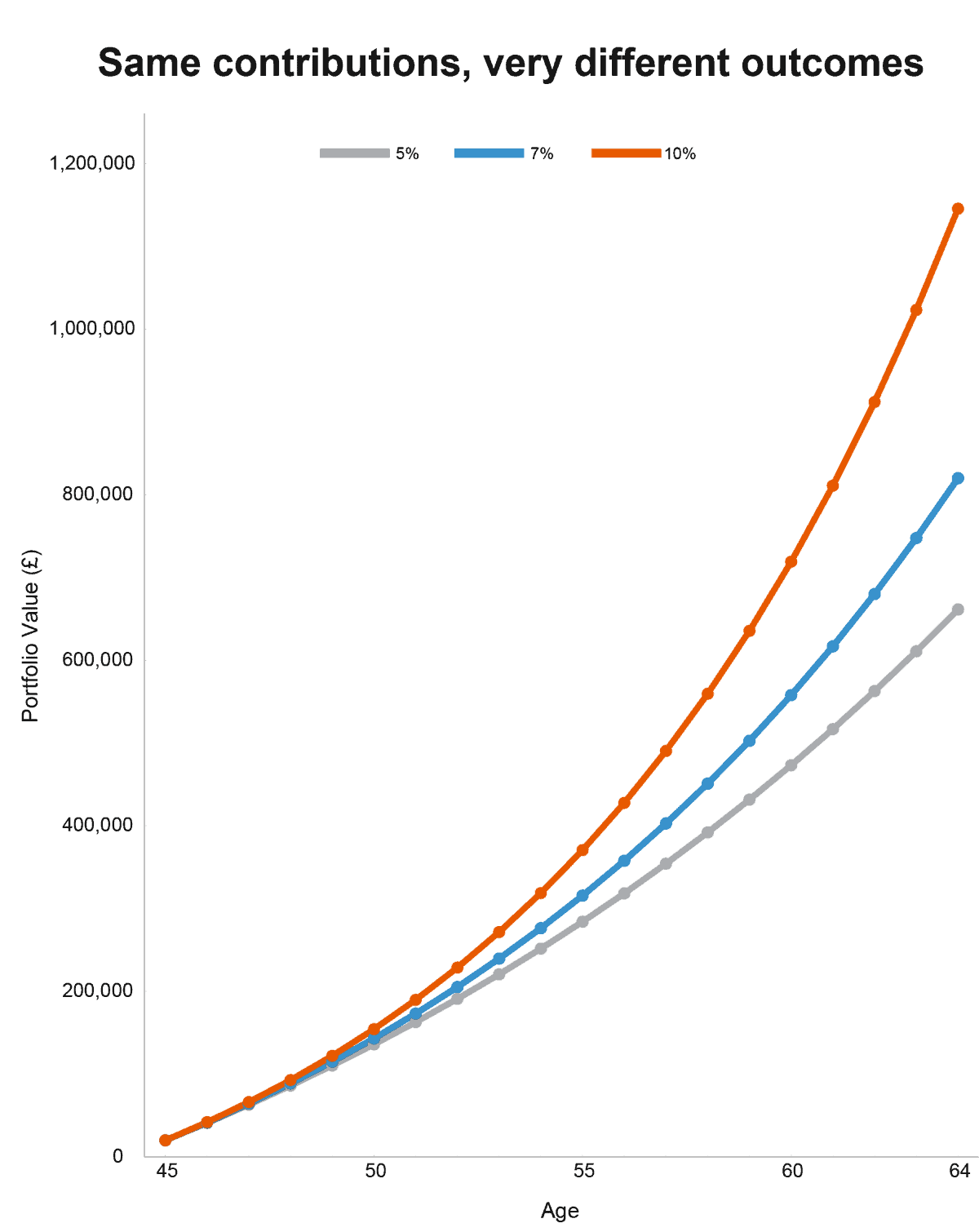
Chart generated by author

That distinction matters. It shows that long-term outcomes are not driven purely by how much an investor can afford to contribute each year, but also by how effectively those contributions are allowed to compound.

For many investors, that is an important point of reassurance. Even if someone cannot max out their ISA allowance, consistent investing combined with time in the market can still do much of the heavy lifting.

Consistent performer

Halma  (LSE: HLMA) is a good example of how consistent compounding can quietly build long-term income.

At first glance, it doesn’t stand out as a typical income stock. The dividend yield is less than 1%, far below many of the high-yielding names in the FTSE 100.

But that misses the more important point. Over the long term, Halma has focused on steady growth in earnings and reinvestment across a decentralised group of niche businesses. That has supported both capital growth and rising dividends.

Over the past decade, total shareholder returns have increased by around 374%, while the dividend itself has compounded at roughly 7.2% annually. That combination is what turns a modest starting yield into a much more meaningful income stream over time.

What stands out is that this is not driven by a single cycle or one-off boost. Instead, it reflects a repeatable model of acquisition, reinvestment and organic growth across multiple specialist markets, from safety equipment to healthcare and infrastructure technology.

For ISA investors, that matters. It shows how income can build gradually without relying on chasing the highest starting yield.

The risk is valuation. Halma currently trades on a price-to-earnings ratio of around 40, which leaves little room for disappointment. If earnings growth slows or falls short of expectations, the shares could come under pressure.

Bottom line

Halma is not a high-yield income stock in the traditional sense. But that’s not really the point.

Whether an investor is contributing the maximum ISA allowance each year or building positions more gradually, the principle is the same: consistent investment into high-quality compounders can do much of the heavy lifting over time.

In that sense, even modest and regular ISA contributions can build towards a meaningful second income over time — provided the underlying investments are doing the compounding work.

Should you invest £5,000 in Halma Plc right now?

When investing expert Mark Rogers and his team have a stock tip, it can pay to listen. After all, the flagship Twelfth Magpie Share Advisor newsletter he has run for nearly a decade has provided thousands of paying members with top stock recommendations from the UK and US markets.

And right now, Mark thinks there are 6 standout stocks that investors should consider buying. Want to see if Halma Plc made the list?


Andrew Mackie does not hold any positions in the companies mentioned.

More on Investing Articles

Young female hand showing five fingers.
Investing Articles

3 reasons to consider buying Barclays shares for an ISA or SIPP at £5

Barclays' shares have moved higher recently. And Edward Sheldon sees the potential for further gains given the banking backdrop.

Read more »

Young black colleagues high-fiving each other at work
Investing Articles

How UK shares could build a £339,849 ISA

Is it really possible to achieve a substantial six-figure ISA by investing in UK shares? Based on recent history, James…

Read more »

many happy international football fans watching tv
Investing Articles

The World Cup guide to the FTSE 100

With the World Cup in full swing, Stephen Wright lines up the FTSE 100 against the world's footballing nations. And…

Read more »

Warren Buffett at a Berkshire Hathaway AGM
Investing Articles

No savings at 50? Here’s how to use the Warren Buffett method to target substantial retirement wealth

Warren Buffett made most of his fortune after 50. His stock-picking method could help build a £661,000 retirement pot when…

Read more »

Engineer Project Manager Talks With Scientist working on Computer
Investing Articles

Forget the AI hype! UK stocks offer tangible returns at bargain prices

Stephen Wright thinks investors who prefer proven businesses while everyone else focuses on unprofitable startups should check out UK stocks.

Read more »

Young brown woman delighted with what she sees on her screen
Investing Articles

1 REIT I’ve bought for a lifetime of passive income!

This unloved UK REIT has increased its dividends for 16 years in a row and now pays an impressive 5%…

Read more »

Portrait of elderly man wearing white denim shirt and glasses looking up with hand on chin. Thoughtful senior entrepreneur, studio shot against grey background.
Value Shares

Up 3.5% this month, is it time for UK investors to cycle back into the more domestically-focused FTSE 250 index?

As the FTSE 250 enjoys a resurgence of interest, it’s been quietly edging ahead of the UK’s main index. Mark…

Read more »

DIVIDEND YIELD text written on a notebook with chart
Investing Articles

Are investors looking for income stocks in the wrong places?

Andrew Mackie looks at FTSE 100 income stocks and why the highest yields may not always deliver the most reliable…

Read more »