A Stocks and Shares ISA is often seen as a straightforward way to build long-term wealth.
How much it could be worth after 20 years of investing is a question many investors ask, but the answer is shaped less by any single return assumption and more by how consistently money is added over time.
Regular investing, time in the market, and the ability to keep contributing through both rising and falling markets tend to matter more than trying to predict short-term performance.
Some investors add to their ISA every month without interruption. Others pause during volatility or wait for better entry points. Over two decades, those differences in behaviour can have a far bigger impact than most people expect.
That’s why it can be more useful to look at how a Stocks and Shares ISA might grow under different patterns of long-term investing.
Why consistency matters more than timing
The chart below models three different investing behaviours over a 20-year period using the same long-term market return assumption.
One investor contributes steadily throughout. Another starts smaller before increasing contributions during peak earning years. The third pauses investing entirely for several years before attempting to catch up later.
Despite all three investors eventually committing meaningful amounts of money, the outcomes diverge far more than many might expect.
The consistent investor ultimately builds the largest portfolio because more money spends longer compounding in the market. Meanwhile, the interrupted investor struggles to fully recover despite sharply increasing contributions later on.
The career-growth investor sits somewhere in between. Although contributions start relatively low, rising investment levels during higher earning years still produce a sizeable long-term portfolio.
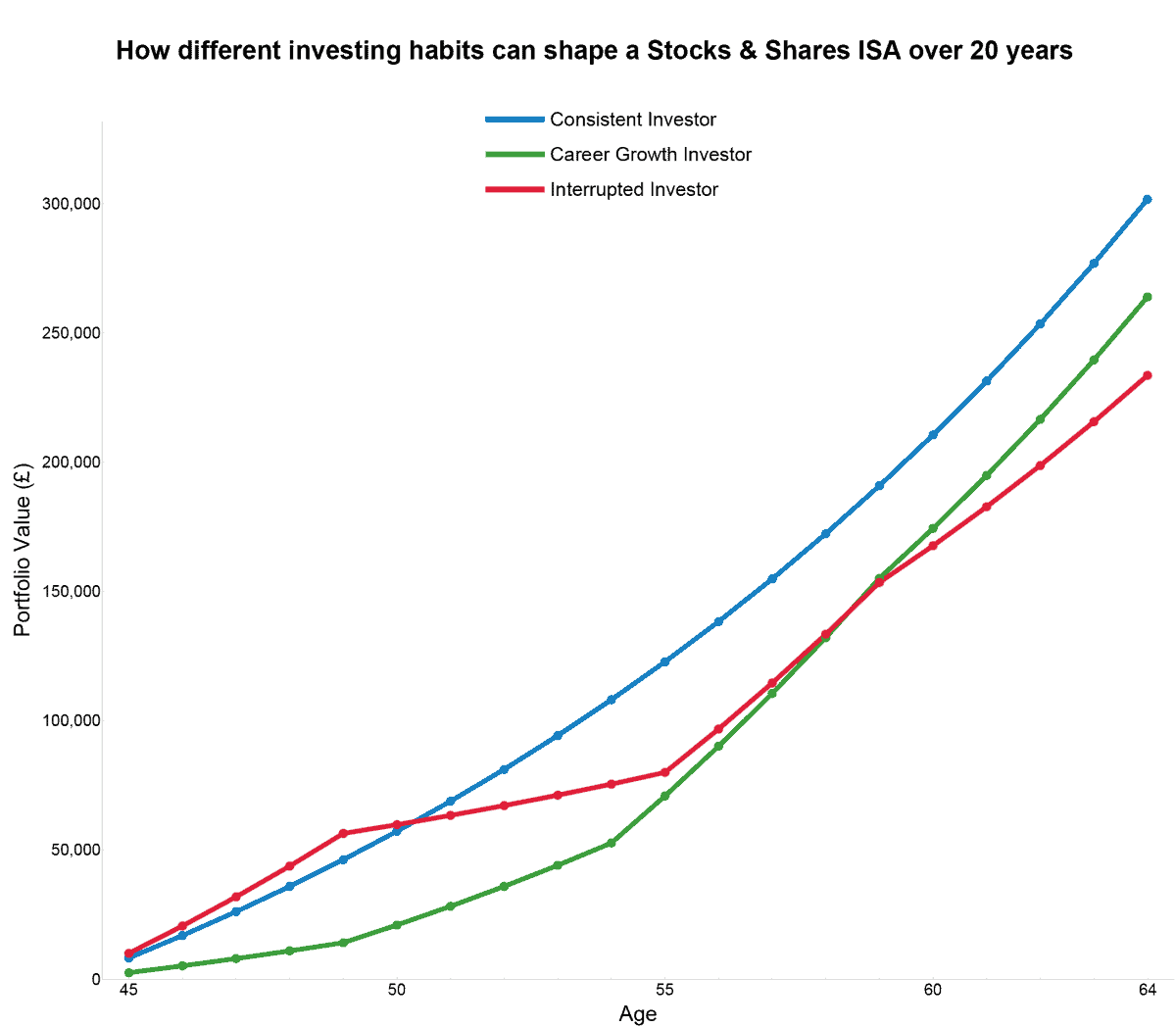
Chart created by author
To me, that highlights one of the most important aspects of long-term ISA investing. Successful investing is not always about finding the perfect moment to buy shares or predicting short-term market moves.
Instead, the biggest driver of long-term portfolio growth is often consistency — continuing to invest through different market cycles and allowing compounding to work over extended periods of time.
A long-term compounder
RELX (LSE: REL) is one of the clearest examples of long-term compounding in the FTSE 100.
Rather than relying on cyclical demand, the business has built a model around recurring revenue, data, and subscription-based analytics that increasingly embed themselves into customer workflows.
In practice, that means once customers adopt its platforms, switching costs are high and usage tends to deepen over time.
Across its divisions, growth is being driven by a steady shift towards higher-value analytics and AI-enabled decision tools.
Across Risk, Legal, and Scientific publishing, more than 90% of revenue is now generated through machine-to-machine data interactions and integrated platforms, reinforcing the predictability of earnings.
This creates a business profile that looks unusually resilient. Revenue growth is consistent, but more importantly, operating leverage continues to improve as digital products scale.
The result is a company that compounds steadily rather than spectacularly — closer in behaviour to a long-term investment portfolio than a traditional cyclical stock.
The main risk is disruption from AI-driven alternatives that could commoditise parts of its data and analytics offering over time. However, RELX’s advantage lies in proprietary datasets, regulatory-grade content, and deep integration into professional workflows, which raises barriers to replacement. Overall, RELX remains a strong example of a quality compounder operating through multiple economic cycles.