
We have some exciting news to share! The Motley Fool UK has now become The Twelfth Magpie -- an independent, UK-owned company, led by our long-serving UK management team — Mark Rogers, Chris Nials and Heather Adlington. In practical terms, it’s the same team you know, now fully focused on serving our UK readers and members.

Just as importantly, our approach remains unchanged: long-term, jargon-free, and on your side. This site is our new home, and there will be extra tweaks made across the coming few days as we settle in. So if anything looks a little off, please bear with us!

The content of this article was relevant at the time of publishing. Circumstances change continuously and caution should therefore be exercised when relying upon any content contained within this article.

How much would I need in an ISA to earn £20,000 a year in passive income?

This writer explores how an ISA could generate £20,000 annually in passive income – and what a simple chart reveals about the power of time and flexibility.

| More on:
Tŵr Mawr lighthouse (meaning "great tower" in Welsh), on Ynys Llanddwyn on Anglesey, Wales, marks the western entrance to the Menai Strait.

Image source: Getty Images

You’re reading a free article with opinions that may differ from The Twelfth Magpie’s Premium Investing Services. Become a member today to get instant access to our top analyst recommendations, in-depth research, investing resources, and more. Learn more, and get a free 'Best Buy Now' stock!.

And ISA is one of those uniquely British inventions that are often viewed far too narrowly. The main point of them isn’t just how much you save, but how time turns those savings into long-term passive income – and the choices that come with it.

What time really buys

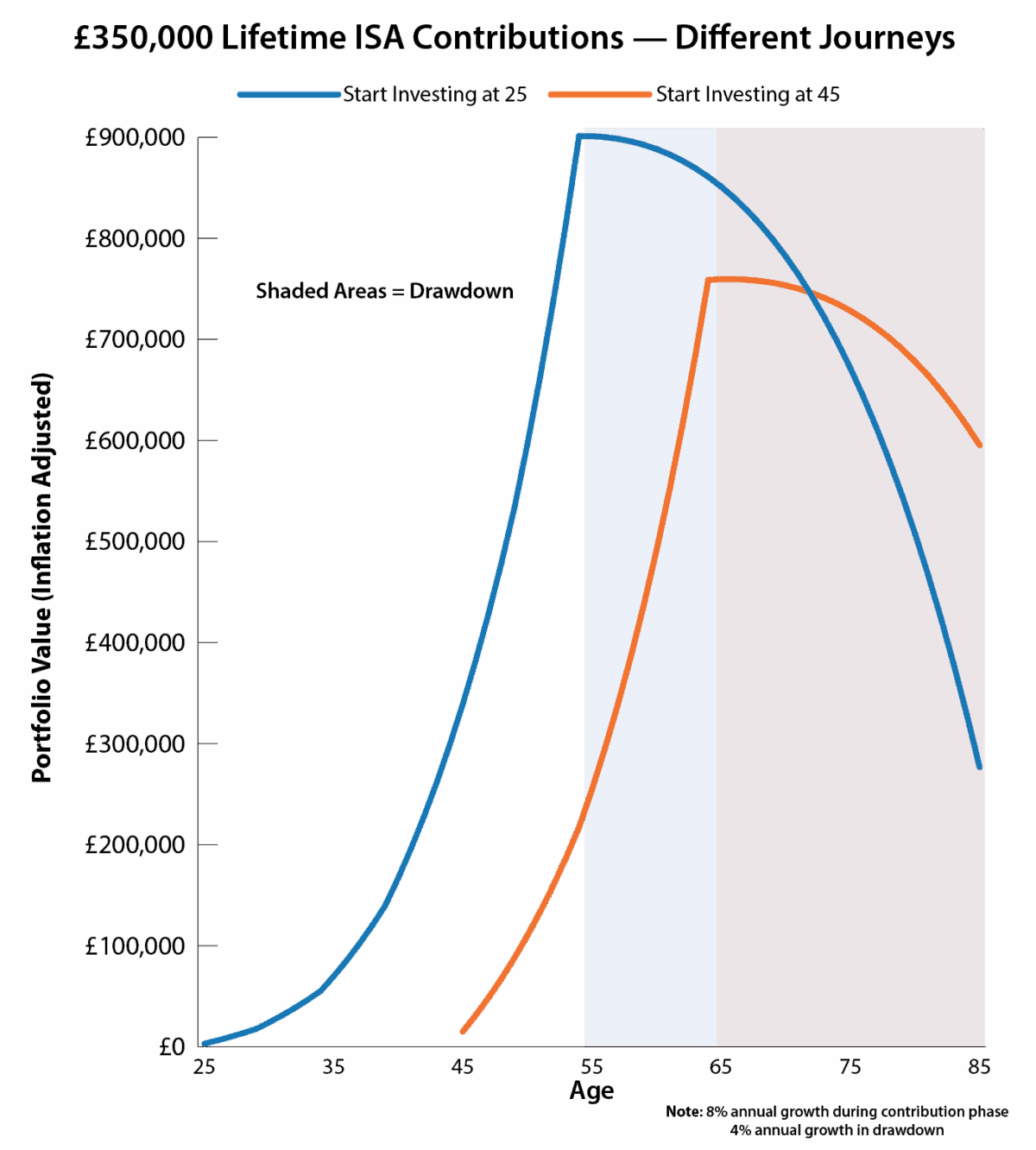
The chart tells the story better than any spreadsheet ever could. Two investors. The same total contributions. Very different starting points. One starts early and builds gradually. The other starts much later and saves hard. By retirement, the gap in portfolio size isn’t as dramatic as many might expect. But how they get there is everything.
Should you buy Prudential Plc shares today?

Before you decide, please take a moment to review this report first. Despite ongoing uncertainties from US tariffs to global conflicts, Mark Rogers and his team believe many UK shares still trade at substantial discounts, offering savvy investors plenty of potential opportunities to learn about.

That’s why this could be an ideal time to secure this valuable research – Mark’s analysts have scoured the markets to reveal 5 of his favourite long-term ‘Buys’. Please, don’t make any big decisions before seeing them.

Chart showing two investment journeys investing in an ISA

Chart generated by author

The £20,000 income shown is inflation-adjusted. That matters. It’s why the earlier starter appears to withdraw more at the outset – prices have had decades to rise quietly in the background. The later starter begins withdrawals sooner, so the initial income looks lower in today’s terms.

Returns are also assumed to fall in retirement. Not because markets suddenly stop working, but because most people naturally reduce risk once their salary ends. Growth gives way to preservation. It’s a subtle shift, but over long retirements, it really adds up.

Optionality

Where time really earns its keep is before retirement. Starting earlier creates choices during your working life: the freedom to pause contributions, take career breaks, ride out market crashes, or simply ease off when life gets in the way.

Early contributions do most of the heavy lifting. Later ones can still be powerful – but they’re far less forgiving.

The late-starter route can absolutely work. But it demands consistency, higher savings rates, and leaves much less room for error if plans change.

This isn’t about a right or wrong approach. It’s about understanding what time actually buys you. The chart doesn’t just show growth – it shows how starting earlier turns flexibility itself into an asset.

Under the radar

Many investors assume the only way to build passive income is by owning high-yielding shares. I don’t take that view.

You see, I didn’t buy Asian insurance giant Prudential (LSE: PRU) for its headline yield – currently around 2%. Instead I bought it for the long-term compounding opportunity across underinsured Asian markets. Insurance penetration remains in the low-single-digits, while the region’s protection gap is estimated at more than $100trn. That’s a powerful backdrop for growth.

In 2025, the shares are up 75%, making them the best performer among its FTSE 100 insurance peers. Even so, I’d argue the stock still sits under the radar for many investors.

China exposure does introduce volatility, and policy risk shouldn’t be ignored. The bursting of the property bubble has clearly dented the country’s growth story. But much of that uncertainty appears to be reflected in the valuation, in my opinion.

What really appeals to me is the capital flexibility. Between 2024 and 2027, Prudential expects to return more than $5bn to shareholders, combining a 10% annual increase in the dividend with a $2bn share buyback programme.

With the Chinese government actively encouraging stock market participation, Prudential looks well placed to benefit. Strong distribution, a trusted brand, and deep expertise across Asian markets are why it earns a place in my Stocks and Shares ISA. It’s not a pure income play today – but it gives me valuable optionality for the future.


Andrew Mackie owns shares in Prudential. The Motley Fool UK has recommended Prudential Plc. Views expressed on the companies mentioned in this article are those of the writer and therefore may differ from the official recommendations we make in our subscription services such as Share Advisor, Hidden Winners and Pro. Here at The Motley Fool we believe that considering a diverse range of insights makes us better investors.

More on Investing Articles

DIVIDEND YIELD text written on a notebook with chart
Investing Articles

I’m targeting a yearly income of £6,898 from £20,000 in this FTSE heavyweight!

This FTSE dividend play looks far too cheap for the cash it throws off — and the mix of rising…

Read more »

Passive income text with pin graph chart on business table
Investing Articles

How much would I need to invest in this FTSE 100 dividend gem to aim for £14,754 a year in passive income?

Passive income is the goal for many investors, and this FTSE dividend star highlights the qualities that can turn long‑term…

Read more »

View over Old Man Of Storr, Isle Of Skye, Scotland
Investing Articles

How much do you need in a SIPP to earn a £667 monthly passive income?

Harvey Jones shows how investors could use the generous tax breaks available on a Self-Invested Personal Pension, or SIPP, to…

Read more »

Happy male couple looking at a laptop screen together
Investing Articles

Up 50% with a stunning 6.4% yield! How do Aviva shares do it?

Harvey Jones is hugely impressed by the recent performance of Aviva shares, and examines why the FTSE 100 insurer has…

Read more »

Satellite on planet background
Investing Articles

Down 19% to under £20! Is now exactly the right time for me to capitalise on BAE Systems’ bargain-basement share price?

BAE Systems’ share price has dropped sharply, but a far bigger long term demand cycle is only just beginning. Here’s…

Read more »

Person holding magnifying glass over important document, reading the small print
Investing Articles

Closing in on £33 and around an all‑time high, is this FTSE 250 favourite seriously mispriced?

With the shares pushing into record territory, I’ve revisited the underlying business, its growth outlook and the valuation picture investors…

Read more »

Close-up of British bank notes
Investing Articles

£20,000 invested in Barclays shares a year ago is now worth…

Barclays shares have quietly delivered a 41% return in just 12 months — and the long term numbers suggest the…

Read more »

Young black woman walking in Central London for shopping
Investing Articles

£9,000 in an ISA? Here’s how to target a £675 passive income with 7% investment trusts

Investment trusts can offer a huge and stable passive income every year. Royston Wild reveals three to consider -- including…

Read more »