We have some exciting news to share! The Motley Fool UK has now become The Twelfth Magpie -- an independent, UK-owned company, led by our long-serving UK management team — Mark Rogers, Chris Nials and Heather Adlington. In practical terms, it’s the same team you know, now fully focused on serving our UK readers and members.

Just as importantly, our approach remains unchanged: long-term, jargon-free, and on your side. This site is our new home, and there will be extra tweaks made across the coming few days as we settle in. So if anything looks a little off, please bear with us!

The content of this article was relevant at the time of publishing. Circumstances change continuously and caution should therefore be exercised when relying upon any content contained within this article.

No savings at 40? Here’s how to try and build a £500k SIPP

The SIPP is an incredible vehicle for building a more comfortable retirement. Dr James Fox explains how it can be fully leveraged.

| More on:

Image source: Getty Images

You’re reading a free article with opinions that may differ from The Twelfth Magpie’s Premium Investing Services. Become a member today to get instant access to our top analyst recommendations, in-depth research, investing resources, and more. Learn more, and get a free 'Best Buy Now' stock!.

The SIPP, or Self-Invested Personal Pension, is one of the most flexible and tax-efficient ways to save for retirement.

For anyone reaching 40 with little or no savings, the idea of building a £500k pension pot might seem out of reach — but it’s not impossible.

Should you buy Monks Investment Trust Plc shares today?

Before you decide, please take a moment to review this report first. Despite ongoing uncertainties from US tariffs to global conflicts, Mark Rogers and his team believe many UK shares still trade at substantial discounts, offering savvy investors plenty of potential opportunities to learn about.

That’s why this could be an ideal time to secure this valuable research – Mark’s analysts have scoured the markets to reveal 5 of his favourite long-term ‘Buys’. Please, don’t make any big decisions before seeing them.

With disciplined contributions, smart investing, and the power of compounding, it’s still achievable over a 25-year horizon.

A SIPP allows investors to choose their own funds, shares, bonds, or ETFs, giving greater control over long-term returns compared with traditional workplace pensions. The key is starting now and sticking to a well-diversified, growth-focused strategy.

Please note that tax treatment depends on the individual circumstances of each client and may be subject to change in future. The content in this article is provided for information purposes only. It is not intended to be, neither does it constitute, any form of tax advice. Readers are responsible for carrying out their own due diligence and for obtaining professional advice before making any investment decisions.

Still time to compound

The magic of investing over a long period of time is compounding. This is when our investment start generating returns on previous returns. This is exponential growth.

So, how would one create a £500,000 SIPP from the age of 40? Well, here’s one theoretical calculation.

If a saver puts £640 per month into their pension, and then receives basic tax relief of 20%, the total monthly investment would be £800. Assuming 8% annualised growth, this portfolio would reach £500,000 in 20.5 years.

In turn, this could generate an income worth around £20,000 per year. It might not be enough to retire on, but it’ll be complemented by the State Pension when that age — whatever it may be in 20/30-odd years — kicks in.

The reality is that anyone looking to rely on the SIPP to take an early retirement may need a few more years of compounding.

That’s because after 25 years, this portfolio would be worth £760,000. That means it could deliver more than £30,000 annually.

The longer we let it grow, the more impressive the rate of growth.
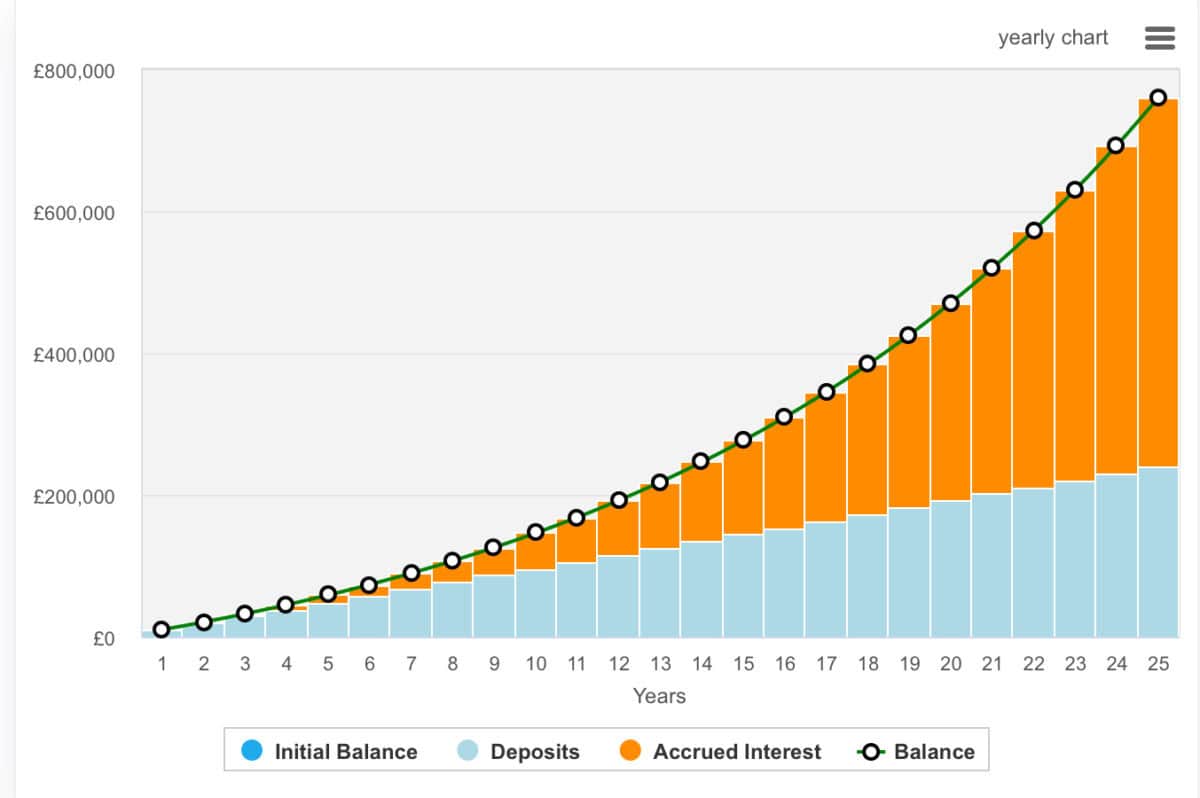
Source: thecalculatorsite.com

Where to invest?

The tricky part is knowing where to invest. Many novice investors will start by taking positions in diversified investment opportunities. This includes vehicles like ETFs or trusts.

One great place to start is Baillie Gifford’s Scottish Mortgage Investment Trust or even The Monks Investment Trust (LSE:MNKS).

The Monks Investment Trust offers investors an enticing route to long-term capital growth through a globally diversified equity strategy.

Rather than chasing short-term gains, Monks focuses on businesses addressing major global challenges in innovative ways. This includes those capable of reducing costs or transforming the quality of services.


The trust’s portfolio includes household names such as NvidiaMicrosoft, and TSMC, alongside differentiated holdings like The Schiehallion Fund.

It has outperformed the FTSE All World Index over one year and 10 years, although it lags on a three- and five-year basis — it’s up 293% over 10 years.

However, investors should be aware that the trust is leveraged. This means it uses borrowing to finance some of its investments. Great when stocks are moving up, but less good when they’re in reverse.

Today, it’s trading at a 5.3% discount to net asset value (NAV) and with low ongoing charges of 0.43%, Monks represents an option worth considering.

James Fox has positions in Nvidia, Scottish Mortgage Investment Trust Plc, and The Monks Investment Trust Plc. The Motley Fool UK has recommended Microsoft, Nvidia, and Taiwan Semiconductor Manufacturing. Views expressed on the companies mentioned in this article are those of the writer and therefore may differ from the official recommendations we make in our subscription services such as Share Advisor, Hidden Winners and Pro. Here at The Motley Fool we believe that considering a diverse range of insights makes us better investors.

More on Investing Articles

A hiker and their dog walking towards the mountain summit of High Spy from Maiden Moor at sunrise
Investing Articles

7.5% yields! Here are 2 very different dividend stocks to consider buying in June

Dividend stocks can be great investments, but they’re not all the same. Stephen Wright outlines two for passive income investors…

Read more »

Person holding magnifying glass over important document, reading the small print
Investing Articles

Takeover talk! But how much is a £10,000 investment in easyJet shares 5 years ago worth today?

How can UK stocks with high dividend yields help investors earn a meaningful second income from the price of a…

Read more »

Middle aged businesswoman using laptop while working from home
Investing Articles

Up 41% in 12 months are Barclays shares still worth buying?

Andrew Mackie explores Barclays shares and argues the market may still be valuing the bank using an outdated playbook, despite…

Read more »

Little girl helping her Grandad plant tomatoes in a greenhouse in his garden.
Investing Articles

Why are ITM Power shares 69% off?

ITM Power shares are among the hottest UK stocks of 2026. So how come the share price is still down…

Read more »

Close-up of British bank notes
Investing Articles

As British American Tobacco shares dip, is this a hot buying opportunity?

Are British American Tobacco shares on their way to completing another decade of dividend growth? Let's check out this latest…

Read more »

DIVIDEND YIELD text written on a notebook with chart
Investing Articles

I’m targeting a yearly income of £6,898 from £20,000 in this FTSE heavyweight!

This FTSE dividend play looks far too cheap for the cash it throws off — and the mix of rising…

Read more »

Passive income text with pin graph chart on business table
Investing Articles

How much would I need to invest in this FTSE 100 dividend gem to aim for £14,754 a year in passive income?

Passive income is the goal for many investors, and this FTSE dividend star highlights the qualities that can turn long‑term…

Read more »

View over Old Man Of Storr, Isle Of Skye, Scotland
Investing Articles

How much do you need in a SIPP to earn a £667 monthly passive income?

Harvey Jones shows how investors could use the generous tax breaks available on a Self-Invested Personal Pension, or SIPP, to…

Read more »