
We have some exciting news to share! The Motley Fool UK has now become The Twelfth Magpie -- an independent, UK-owned company, led by our long-serving UK management team — Mark Rogers, Chris Nials and Heather Adlington. In practical terms, it’s the same team you know, now fully focused on serving our UK readers and members.

Just as importantly, our approach remains unchanged: long-term, jargon-free, and on your side. This site is our new home, and there will be extra tweaks made across the coming few days as we settle in. So if anything looks a little off, please bear with us!

The content of this article was relevant at the time of publishing. Circumstances change continuously and caution should therefore be exercised when relying upon any content contained within this article.

The simple way to try and build a £27m SIPP

Imagine having £27m in a SIPP. Well, it’s possible, but it typically requires Britons to start early, very early. Dr James Fox explains how it’s done.

| More on:
Fathers Walking With Their Little Boy

Image source: Getty Images

You’re reading a free article with opinions that may differ from The Twelfth Magpie’s Premium Investing Services. Become a member today to get instant access to our top analyst recommendations, in-depth research, investing resources, and more. Learn more, and get a free 'Best Buy Now' stock!.

It sounds implausible. A £27m Self-Invested Personal Pension (SIPP) from just a few thousand pounds a year. But with a long enough runway and the power of compounding, it becomes a mathematical possibility.

A SIPP opened at birth and topped up consistently could, in theory, accumulate a fortune over time. Using HMRC’s maximum child SIPP contribution of £3,600 a year (including tax relief), the numbers stack up compellingly if invested wisely from day one.

Should you buy Synectics Plc shares today?

Before you decide, please take a moment to review this report first. Despite ongoing uncertainties from US tariffs to global conflicts, Mark Rogers and his team believe many UK shares still trade at substantial discounts, offering savvy investors plenty of potential opportunities to learn about.

That’s why this could be an ideal time to secure this valuable research – Mark’s analysts have scoured the markets to reveal 5 of his favourite long-term ‘Buys’. Please, don’t make any big decisions before seeing them.

Assuming an average annual return of 10% — reflective of US market returns over the past decade — the balance grows modestly at first. By age 10, the pot might stand around £68,000. But the compounding effect gathers pace. By 25, it could top £450,000. By 40, it may pass £2m.

Keep going, and at age 65 — without increasing contributions beyond inflation — the balance could exceed £27m. The secret? Time, tax relief, and long-term exposure to growth assets like equities. This calculation also includes a 1% increase in annual contributions each year to account for potentially larger contributions in the future.
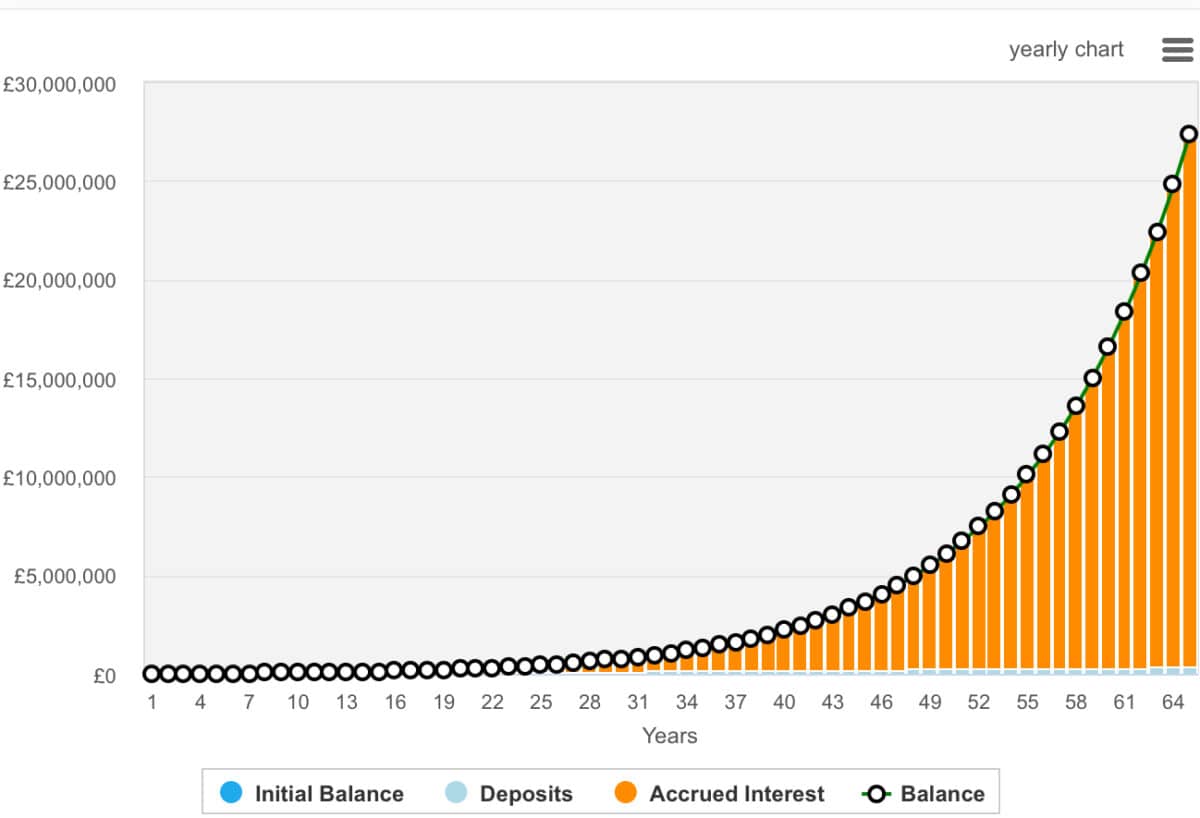
Source: thecalculatorsite.com

Of course, future returns aren’t guaranteed, and inflation would eat into purchasing power. UK investors may also earn more modest returns with UK-focused investments and poor investment decisions can see us lose money. But even under more conservative assumptions, a child’s SIPP could become a meaningful financial asset later in life.

Parents, grandparents, or guardians funding early SIPP contributions could give a child an extraordinary head start. And it’s not just financial, but contributes to an understanding the value of investing early and often. This calculation also involves the child going on to make contributions themselves as they start working. It requires a long-term commitment.

It’s not the flashiest strategy. It doesn’t have to involve hefty bets on tech disrupters or shorting overvalued stocks. It’s simply about starting early and letting compound returns do the heavy lifting.

Where to invest?

Anyone opening a SIPP for a child or loved one has several options when it comes to investing. A simple, hands-off approach might involve low-cost index-tracking funds or investment trusts. These offer instant diversification and a long-term growth orientation, making them ideal for compounding over decades.

Alternatively, more active investors might prefer to build a portfolio one or two stocks at a time. One company I’m watching closely right now is Synectics (LSE:SNX). It’s an AIM-listed specialist in advanced security and surveillance systems.

At just over £53m in market-cap, Synectics trades on just 12.2 times forward earnings, falling to 9.5 times by 2027. Adjusting for its net cash position of £12.1m, that gives a price-to-earnings-to-growth (PEG) ratio of 0.72. This implies the shares could be significantly undervalued based on growth forecasts.

Recent interim results showed revenue up 35%, operating profit up 48%, and earnings per share up 59%. Its growing order book, international expansion, and debt-free balance sheet are all really positive feature.

Of course, as a small-cap, it carries more risks. This including contract concentration and macroeconomic sensitivity as well as a large spread between buying and selling prices. But for long-term investors, Synectics might be worth a closer look. I’ve added it to my watchlist.


James Fox has no position in any of the shares mentioned. The Motley Fool UK has no position in any of the shares mentioned. Views expressed on the companies mentioned in this article are those of the writer and therefore may differ from the official recommendations we make in our subscription services such as Share Advisor, Hidden Winners and Pro. Here at The Motley Fool we believe that considering a diverse range of insights makes us better investors.

More on Investing Articles

Young female couple boarding their plane at the airport to go on holiday.
Investing Articles

Can the Rolls-Royce share price reach £15.97 by the end of August?

The Rolls-Royce share price has had a solid run in the last year. Muhammad Cheema takes a look at whether…

Read more »

Santa Clara offices of NVIDIA
Investing Articles

Up 1,200% in 5 years, here’s why Nvidia could still be a brilliant value stock

An exciting new announcement that could reshape the PC industry has just pushed Nvidia stock... well, just about nowhere really.

Read more »

House models and one with REIT - standing for real estate investment trust - written on it.
Investing Articles

How investing £4.50 a day could set you on the way to a £1,505 monthly second income

How can UK stocks with high dividend yields help investors earn a meaningful second income from the price of a…

Read more »

Investing Articles

Up 103% with a P/E of 261 — is this FTSE 100 stock still worth buying?

One FTSE 100 stock is quietly moving higher while most investors are still looking elsewhere — is the market missing…

Read more »

Concept of two young professional men looking at a screen in a technological data centre
Investing Articles

The smart money thinks AI stocks look risky — but is there still a chance to buy?

According to fund managers, the AI trade is getting crowded. But they still seem to think it’s the place to…

Read more »

Man putting his card into an ATM machine while his son sits in a stroller beside him.
Investing Articles

Barclays shares are 11% below their 52-week high. Could they be a bit of a bargain to consider?

Overpriced or one of the FTSE 100’s hidden gems? James Beard takes a closer look at how the market is…

Read more »

Stack of one pound coins falling over
Investing Articles

Down 65% but yielding 6.7% – is this beaten-down UK stock now a generational bargain?

Harvey Jones says this UK stock is one of the worst FTSE 100 performers but there are sound reasons to…

Read more »

Portrait of elderly man wearing white denim shirt and glasses looking up with hand on chin. Thoughtful senior entrepreneur, studio shot against grey background.
Investing Articles

Is this FTSE stock really 46% undervalued?

Analysts reckon this FTSE stock should be worth nearly 50% more. James Beard considers why there’s so much positivity surrounding…

Read more »