We have some exciting news to share! The Motley Fool UK has now become The Twelfth Magpie -- an independent, UK-owned company, led by our long-serving UK management team — Mark Rogers, Chris Nials and Heather Adlington. In practical terms, it’s the same team you know, now fully focused on serving our UK readers and members.

Just as importantly, our approach remains unchanged: long-term, jargon-free, and on your side. This site is our new home, and there will be extra tweaks made across the coming few days as we settle in. So if anything looks a little off, please bear with us!

The content of this article was relevant at the time of publishing. Circumstances change continuously and caution should therefore be exercised when relying upon any content contained within this article.

When will Barclays shares hit £2?

Barclays shares are among the cheapest on the FTSE 100, trading at just 4.24 times trailing 12-month earnings. So, will the stock push towards £2 soon?

| More on:
Concept of two young professional men looking at a screen in a technological data centre

Image source: Getty Images

You’re reading a free article with opinions that may differ from The Twelfth Magpie’s Premium Investing Services. Become a member today to get instant access to our top analyst recommendations, in-depth research, investing resources, and more. Learn more, and get a free 'Best Buy Now' stock!.

Barclays (LSE:BARC) shares represent one of my biggest holdings. It certainly hasn’t performed overly well for me so far. However, analysts, including those at AJ Bell, have forecast that banking and financial stocks will be among those making the strongest gains over the coming year. So, could we see Barclays pip £2 a share soon?


Should you buy Barclays Plc shares today?

Before you decide, please take a moment to review this report first. Despite ongoing uncertainties from US tariffs to global conflicts, Mark Rogers and his team believe many UK shares still trade at substantial discounts, offering savvy investors plenty of potential opportunities to learn about.

That’s why this could be an ideal time to secure this valuable research – Mark’s analysts have scoured the markets to reveal 5 of his favourite long-term ‘Buys’. Please, don’t make any big decisions before seeing them.

P/E

One of the simplest valuation metrics to consider is the price-to-earnings (P/E) ratio, and this is where Barclays’ discount compared to its peers becomes readily apparent.

Britain’s second largest bank is currently trading at 4.24 times earnings, and 5.6 times forward earnings. This is phenomenally cheap and a fraction of the index average of around 13 times. It’s also notably below the financial sector average of approximately 10 times.

Barclays is the cheapest FTSE 100 bank when using the P/E ratio lens. It’s also considerably cheaper than US peers including Bank of America (9 times) and Goldman Sachs (15 times).

P/B

The price-to-book (P/B) ratio is an important financial metric for investors because it provides insights into a company’s valuation relative to its book value, which is essentially the net asset value of the company.

When we look at Barclays P/B ratio, we can see that the stock is massively discounted versus its tangible net asset value. The company’s P/B ratio is 0.42 times, inferring a 58% discount versus net asset value.
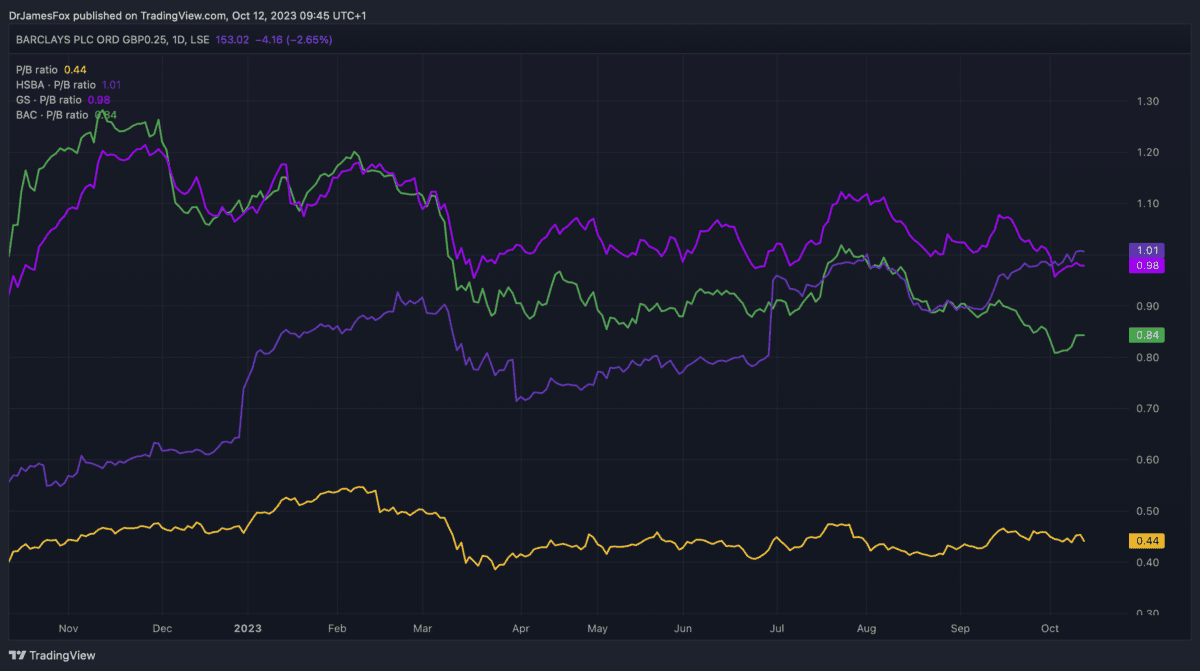
Created at TradingView

The above chart shows how Barclays compares to peers HSBC (1.01 times), Bank of America (0.84 times), and Goldman Sachs (0.98 times). The discount afforded to Barclays is pretty much unprecedented.

Negatives overplayed

Like banks in the US and Europe, Barclays is facing some challenges as interest rates extend beyond the levels considered optimal. These elevated interest rates can exert pressure on the bank’s operations and profitability.

If the situation were to worsen, Barclays could expect credit losses to more than double its current forecast. These are essentially the impairment charges the bank would incur from bad debt. This is because, with interest rates pushing above 5%, individuals and businesses are struggling with their repayments.

However, to date, higher interest rates have had a positive impact on bank earnings. That’s because net interest income has been greater than impairment charges.

The concern is that this could change if the economy takes a turn for the worse, or interest rates rise further. Currently, it appears as if a worst-case scenario will be avoided.

Nonetheless, it’s worth noting that Barclays was the worst performer in the UK regulators bank stress test — under a stress scenario, with Common Equity Tier 1 (a measure of liquidity) levels falling to 8.6% — which is still some way above the pass threshold.

The big question is whether Barclays deserves this considerable discount when its peers are exposed to very similar pressures.

For me, it’s an easy one. The risks are more than priced into the Barclays share price. If we apply a fair P/E ratio of eight times, the Barclays share price would be closer to £3 than £2. A similar result appears when we use a fairer P/B ratio.


HSBC Holdings is an advertising partner of The Ascent, a Motley Fool company. Bank of America is an advertising partner of The Ascent, a Motley Fool company. James Fox has positions in Barclays Plc, HSBC Holdings, and Lloyds Banking Group Plc. The Motley Fool UK has recommended Aj Bell Plc, Barclays Plc, HSBC Holdings, and Lloyds Banking Group Plc. Views expressed on the companies mentioned in this article are those of the writer and therefore may differ from the official recommendations we make in our subscription services such as Share Advisor, Hidden Winners and Pro. Here at The Motley Fool we believe that considering a diverse range of insights makes us better investors.

More on Investing Articles

Tree lined "tunnel" in the English countryside of West Sussex in autumn
Investing Articles

3 UK shares to consider holding in a Stocks and Shares ISA for a decade

Mark Hartley explains why he thinks these three stocks would make great additions to a long-term Stocks and Shares ISA…

Read more »

Hand of person putting wood cube block with word VALUE on wooden table
Investing Articles

Where should value investors look for stocks in June?

Value investors looking for stocks to buy might be uneasy with artificial intelligence. But other industries look much more attractive…

Read more »

Investing Articles

The latest broker outlooks on Greggs shares look wacky, so what’s happening?

Analyst price targets for Greggs shares are creating some mixed sentiments on where the high-street baker might go next in…

Read more »

Caerphilly Castle, and reflection in the moat.
Investing Articles

2 FTSE 100 dividend stocks that stand out for shareholder returns

Andrew Mackie highlights two FTSE 100 dividend stocks where disciplined capital allocation could continue driving shareholder returns.

Read more »

Senior Adult Black Female Tourist Admiring London
Investing Articles

Just 9% of us can expect a ‘comfortable’ retirement! Could UK shares be the answer?

Millions of Brits could miss out on the retirement of their dreams. Might they avoid this by investing in UK…

Read more »

DIVIDEND YIELD text written on a notebook with chart
Investing Articles

3 passive income shares to consider buying for a 7% yield

Harvey Jones picks out three UK income shares that offer terrific dividends and are trading at tempting valuations. None of…

Read more »

Businessman hand stacking up arrow on wooden block cubes
Investing Articles

How much just £4,160 invested in Rolls-Royce shares 5 years ago is worth now

Rolls-Royce shares have been on a remarkable run of late. Ken Hall takes a look at the key drivers and…

Read more »

Cropped shot of an affectionate young couple posing with a bunch of flowers in their kitchen on their anniversary
Investing Articles

The FTSE 100’s Howden Joinery just made a bold move — should investors care?

Andrew Mackie looks at the FTSE 100’s Howden Joinery and its move into online kitchens, asking what the acquisition means…

Read more »