We have some exciting news to share! The Motley Fool UK has now become The Twelfth Magpie -- an independent, UK-owned company, led by our long-serving UK management team — Mark Rogers, Chris Nials and Heather Adlington. In practical terms, it’s the same team you know, now fully focused on serving our UK readers and members.

Just as importantly, our approach remains unchanged: long-term, jargon-free, and on your side. This site is our new home, and there will be extra tweaks made across the coming few days as we settle in. So if anything looks a little off, please bear with us!

The content of this article was relevant at the time of publishing. Circumstances change continuously and caution should therefore be exercised when relying upon any content contained within this article.

If I’d put £10k in Lloyds shares 5 years ago, here’s what I’d have today!

Once the darling of the FTSE 100, today, Lloyds’ shares trade for just a fraction of their pre-financial crash price. Let’s take closer look.

| More on:
Young Caucasian man making doubtful face at camera

Image source: Getty Images

You’re reading a free article with opinions that may differ from The Twelfth Magpie’s Premium Investing Services. Become a member today to get instant access to our top analyst recommendations, in-depth research, investing resources, and more. Learn more, and get a free 'Best Buy Now' stock!.

Lloyds (LSE:LLOY) shares currently trade for 41p. That must have been almost unthinkable back in the late 90s when the stock was worth around £5 a share. Of course, a lot has changed since then.


Should you buy Lloyds Banking Group Plc shares today?

Before you decide, please take a moment to review this report first. Despite ongoing uncertainties from US tariffs to global conflicts, Mark Rogers and his team believe many UK shares still trade at substantial discounts, offering savvy investors plenty of potential opportunities to learn about.

That’s why this could be an ideal time to secure this valuable research – Mark’s analysts have scoured the markets to reveal 5 of his favourite long-term ‘Buys’. Please, don’t make any big decisions before seeing them.

Five-year trend

Over the past five years, the FTSE 100 has grown by 2%. That’s a very meagre return. Obviously, there have been challenges, including Brexit, the pandemic, the cost-of-living crisis, and now rising interest rates that have raised the attractiveness of debt and cash over equities.

However, Lloyds has greatly underperformed the lacklustre FTSE 100. The lender’s share price is down 29% over five years. As such, a £10,000 investment then would be worth £7,100 today. Of course, there have been dividends. I’d have recouped around £1,200 over the period.

With many investors looking for returns in the region of 8-12%, Lloyds would have been a sizeable drag on mine over the five-year period. The chart below highlights the performance of the Lloyds share price versus the FTSE 100, FTSE 250, and the S&P 500.
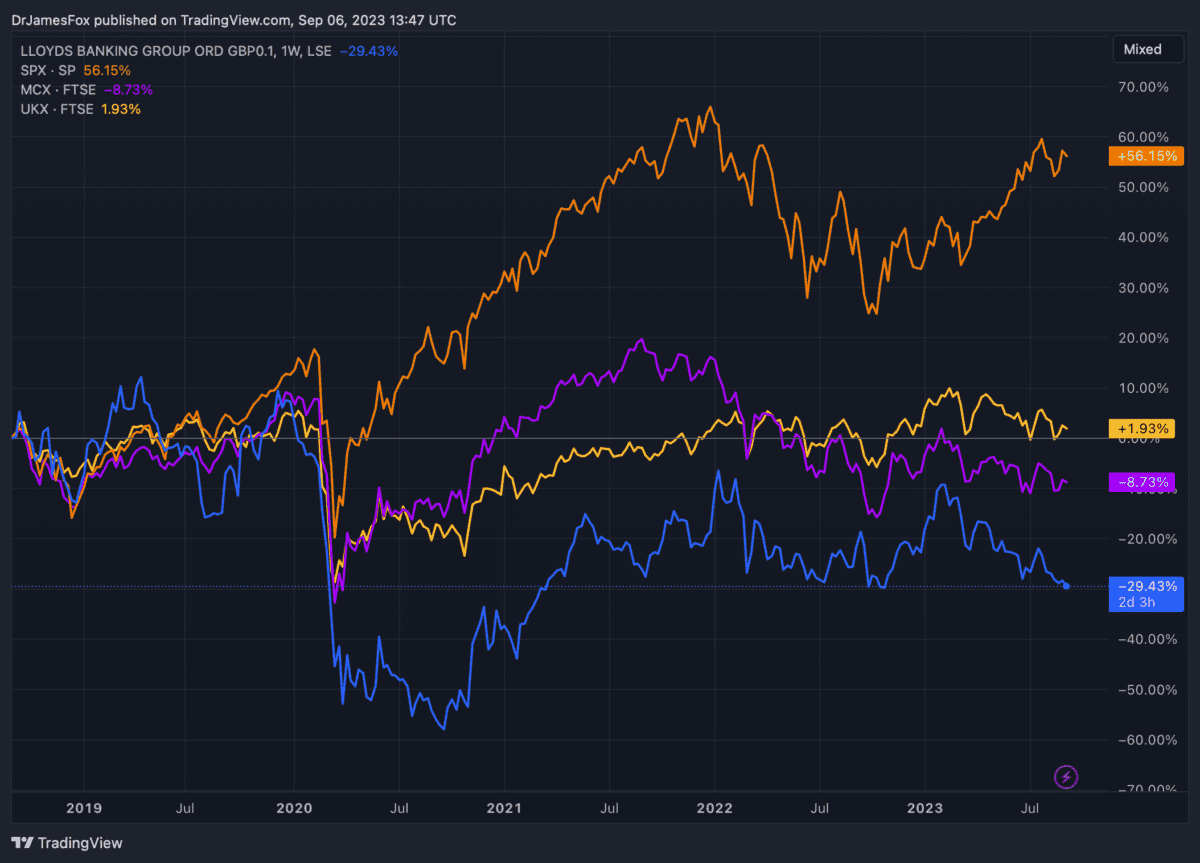
Created at TradingView

Headwinds and tailwinds

With the exception of the early days of the pandemic, Lloyds is trading near its five-year low. While novice investors may assume banks are performing extraordinarily well in the current high-rate environment, that’s not the case.

The problem is that interest rates have extended far beyond levels normally considered optimal. And this has raised concerns about the threat of mass defaults. Under Lloyds’ worst-case scenario, the bank anticipates expected credit losses of £10.1bn.

However, this is some way above the ‘base case’ outcome. Moreover, I’d hope the Bank of England would take action before we reach a mass default situation.
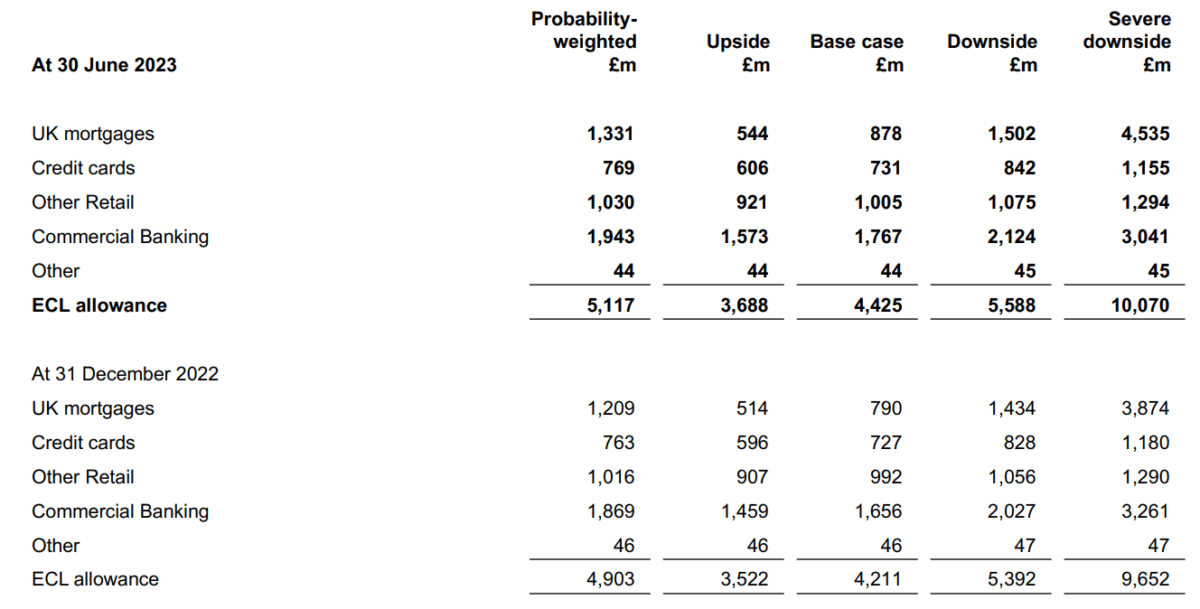
Source: Lloyds H1 results (page 101) showing credit loss estimates

It’s also worth noting that Lloyds was the second-best-performing bank in the recent stress test. In the stress scenario, Lloyds’ CET1 would decline to 11.6%, placing it ahead of all banks except Nationwide –Lloyds’s CET1 ratio fell from 14.7% (as noted in the stress test) to 14.2% in the H1 results.

To date however, the tailwind associated with higher rates — higher net interest income — has surpassed impairment charges.

In H1, net interest income rose 14% to £7bn versus £6.1bn last year. Meanwhile, Lloyds impairments rose 76% to £662m in H1. Consequently, underlying profit before impairments rose 16% to £4.7bn.

Undervalued

Despite the concern about mass defaults, data suggests that the bank is oversold and that it remains meaningfully undervalued. The lender trades at 5.2 times TTM earnings and 5.6 times forward earnings. This makes it one of the cheapest company’s on the FTSE 100.

Not having an investment arm, Lloyds is more exposed to the interest rate climate than its peers. However, this doesn’t account for the size of the discount versus its international peers. The global banking sector trades on TTM multiple of 9.4 times and forward multiple of 9.7 times.

As with any investment, there is risk. However, the risks appear to be more than priced in.

James Fox has positions in Lloyds Banking Group Plc. The Motley Fool UK has recommended Lloyds Banking Group Plc. Views expressed on the companies mentioned in this article are those of the writer and therefore may differ from the official recommendations we make in our subscription services such as Share Advisor, Hidden Winners and Pro. Here at The Motley Fool we believe that considering a diverse range of insights makes us better investors.

More on Investing Articles

Happy parents playing with little kids riding in box
Dividend Shares

How much is needed in a Stocks and Shares ISA to target a £1,370 monthly passive income?

Want to retire early and live off passive income? James Beard explains how someone could aim to do this with…

Read more »

Rolls-Royce Hydrogen Test Rig at Loughborough University
Investing Articles

Here’s how nuclear energy could reignite a fire under Rolls-Royce shares

Mark Hartley weighs up the long-term dividend potential of Rolls-Royce shares and how its SMR division could help drive growth.

Read more »

A rear view of a female in a bright yellow coat walking along the historic street known as The Shambles in York, UK which is a popular tourist destination in this Yorkshire city.
Investing Articles

Here’s how much is needed in an ISA to earn £46,918 of passive income a year

Mark Hartley takes a look at the kind of investment power needed to bring in enough passive income for a…

Read more »

Investing Articles

3 beaten-down FTSE 100 shares to consider buying and holding for a decade

Harvey Jones says the real rewards of investing in FTSE 100 shares come over the long term. He thinks these…

Read more »

Three signposts pointing in different directions, with 'Buy' 'Sell' and 'Hold' on
Investing Articles

At 237.8%, the stock market total value-to-GDP ratio is way too high. Here’s what I’m doing.

With the stock market looking more overvalued than at any other time in history, Mark Hartley carefully considers how UK…

Read more »

Chalkboard representation of risk versus reward on a pair of scales
Investing Articles

Greggs shares may look cheap – but they expose a classic investing dilemma!

Greggs shares seem to be going nowhere fast. This shareholder reckons it could be an example of a classic stock…

Read more »

Investing Articles

Here’s how long it could take to go from zero to a £1m Stocks and Shares ISA

Ben McPoland sees this dividend-paying ETF as a solid contender for inclusion in a diversified Stocks and Shares ISA today.

Read more »

Business manager working at a pub doing the accountancy and some paperwork using a laptop computer
Investing Articles

Down 33%, is there a once-in-a-decade chance to buy this quality FTSE 100 stock?

This FTSE 100 stock's been written off as a loser in the age of artificial intelligence. But what if the…

Read more »