We have some exciting news to share! The Motley Fool UK has now become The Twelfth Magpie -- an independent, UK-owned company, led by our long-serving UK management team — Mark Rogers, Chris Nials and Heather Adlington. In practical terms, it’s the same team you know, now fully focused on serving our UK readers and members.

Just as importantly, our approach remains unchanged: long-term, jargon-free, and on your side. This site is our new home, and there will be extra tweaks made across the coming few days as we settle in. So if anything looks a little off, please bear with us!

The content of this article was relevant at the time of publishing. Circumstances change continuously and caution should therefore be exercised when relying upon any content contained within this article.

At 42p, Lloyds shares look cheap! Here’s what the charts say

Lloyds shares have fallen further in recent weeks as the market prices in more interest rate rises. Dr James Fox explores this opportunity.

| More on:
Young Caucasian woman with pink her studying from her laptop screen

Image source: Getty Images

You’re reading a free article with opinions that may differ from The Twelfth Magpie’s Premium Investing Services. Become a member today to get instant access to our top analyst recommendations, in-depth research, investing resources, and more. Learn more, and get a free 'Best Buy Now' stock!.

Many investors will be aware that Lloyds (LSE:LLOY) shares look cheap compared to its peers. But, of course, this reflects the bank’s relative exposure to perceived risk and its efficiency at generating income from assets.

However, when we delve deeper, do Lloyds shares still look undervalued? Let’s explore.

Should you buy Lloyds Banking Group Plc shares today?

Before you decide, please take a moment to review this report first. Despite ongoing uncertainties from US tariffs to global conflicts, Mark Rogers and his team believe many UK shares still trade at substantial discounts, offering savvy investors plenty of potential opportunities to learn about.

That’s why this could be an ideal time to secure this valuable research – Mark’s analysts have scoured the markets to reveal 5 of his favourite long-term ‘Buys’. Please, don’t make any big decisions before seeing them.

Risk exposure

Lloyds, and peer Barclays, haven’t been overly popular with investors since the financial crisis. However, these cyclical institutions currently trade at a discount even versus their historical average valuations. On several metrics, Barclays is actually cheaper than Lloyds.

However, focusing on Lloyds, we can observe that it trades at a considerable discount to the index and most of its peers. It has a price-to-earnings (P/E) ratio of 5.3 and a forward P/E of 5.9. This put it at a considerable discount versus HSBC at 6.6 times, Standard Chartered at 10 times, and Bank of America at 8.8 times.

The primary reasoning for this is Lloyds’s exposure to defaults in this rising interest rate environment. The thing is, higher interest rates are good for banks until they’re not. And with the BoE rate potentially hitting 6%, there are serious concerns about loan defaults.

This impacts Lloyds more than other banks due to its funding mechanics and interest rate sensitive operations. After all, Lloyds doesn’t have an investment arm. As such, if we do see a slew of customer defaults across the loan market, Lloyds will likely be hardest hit.


Still mispriced

Despite this, Lloyds still looks mispriced at 42p. One metric that tells us this is the price-to-book (P/B) ratio. This is used to assess a company’s valuation by comparing its market price per share to its book value per share, which represents the net assets of the company.

In the below chart, we can see that Lloyds trades at 0.73 times the value of its net assets. This, therefore, reflects a discount of 27%. Only Barclays, which is very heavily discounted, trades at a greater discount.
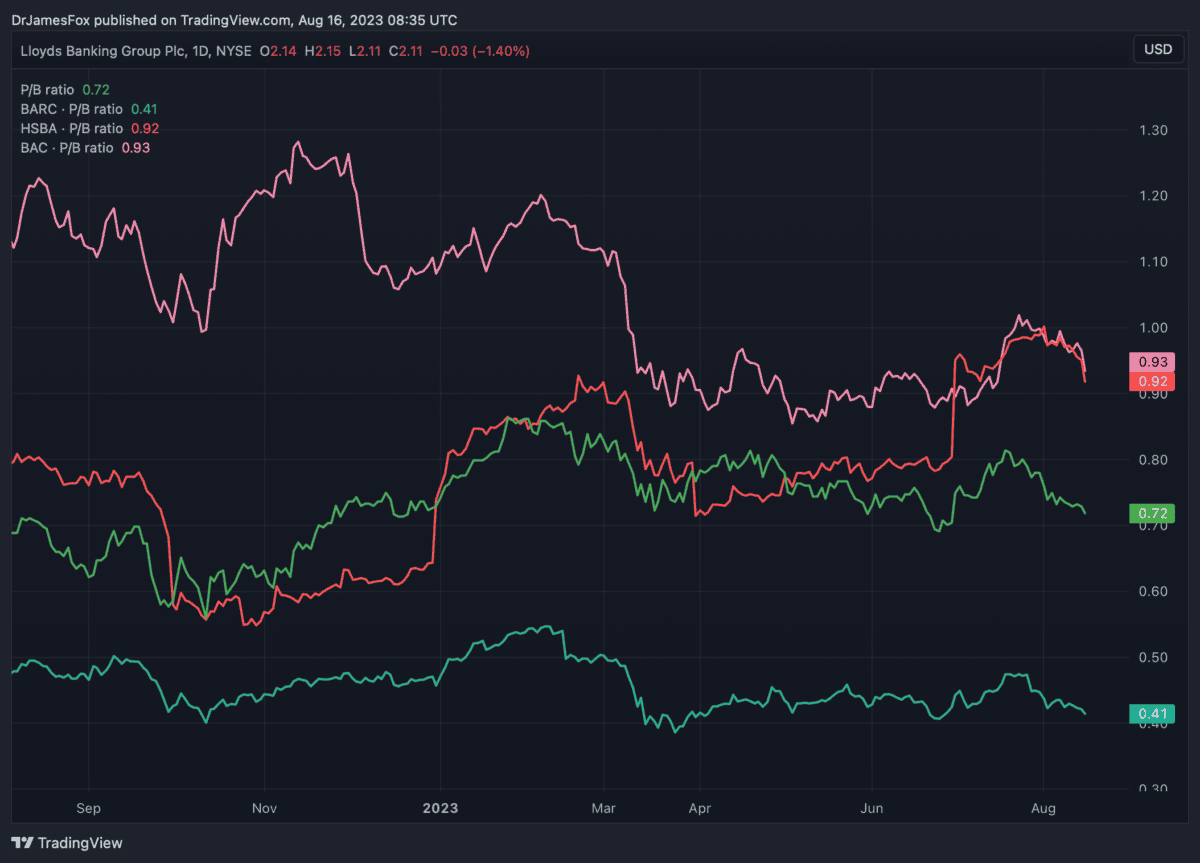
Created at TradingView

While defaults are a concern, it’s important to remember that all UK banks recently passed the stress test. Lloyds was, depending on how you look at it, the second-best performer. Under the stress scenario, Lloyds’s CET1 would fall to 11.6%, putting it ahead of all banks bar Nationwide.

There are, naturally, lots of things to consider. Lloyds has not traditionally been the most efficient at generating returns compared to peers. But in an environment where interest rates fall to around 2%-3%, which they are forecast to do, Lloyds could be a highly efficient business. This RoTE chart, with data until the beginning of 2023, demonstrates this.
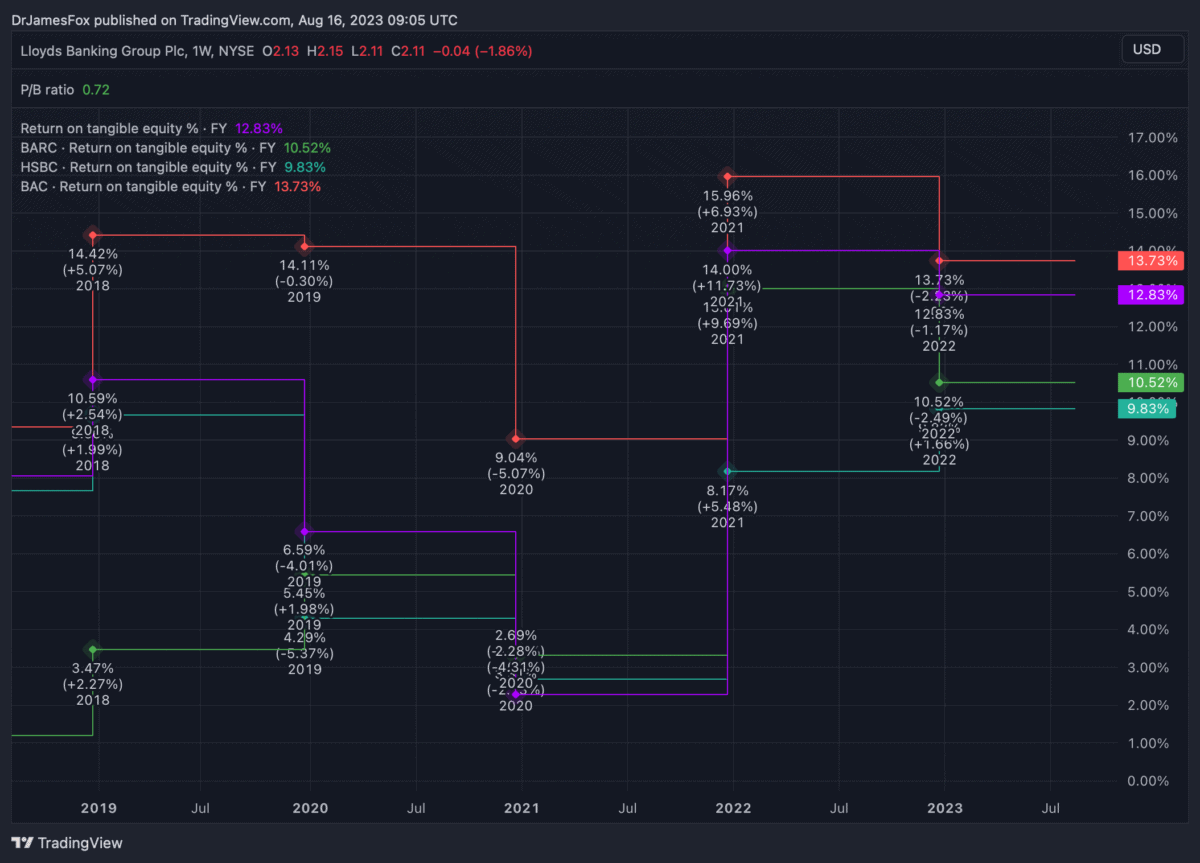
Created at TradingView

Of course, the quicker interest rates fall to the forecast new long-term average, the quicker the Lloyds share price will recover. Investors are certainly risk-off at this moment, and Lloyds carries more risk than its peers. Despite this, I believe it’s a risk worth taking. And I’ve been topping up my portfolio as a result.


HSBC Holdings is an advertising partner of The Ascent, a Motley Fool company. Bank of America is an advertising partner of The Ascent, a Motley Fool company. James Fox has positions in Barclays Plc and Lloyds Banking Group Plc. The Motley Fool UK has recommended Barclays Plc, HSBC Holdings, Lloyds Banking Group Plc, and Standard Chartered Plc. Views expressed on the companies mentioned in this article are those of the writer and therefore may differ from the official recommendations we make in our subscription services such as Share Advisor, Hidden Winners and Pro. Here at The Motley Fool we believe that considering a diverse range of insights makes us better investors.

More on Investing Articles

Woman riding her old fashioned bicycle along the Beach Esplanade at Aberdeen, Scotland.
Investing Articles

How much do you need in a Stocks and Shares ISA to generate £100 a day in passive income?

Andrew Mackie looks at what it takes to build a meaningful passive income inside a Stocks and Shares ISA and…

Read more »

Front view of a young couple walking down terraced Street in Whitley Bay in the north-east of England they are heading into the town centre and deciding which shops to go to they are also holding hands and carrying bags over their shoulders.
Investing Articles

How much second income would it take to cover household bills?

Andrew Mackie explores how a Stocks and Shares ISA could be used to generate a second income capable of covering…

Read more »

Young Caucasian man making doubtful face at camera
Investing Articles

This FTSE 100 share pays no dividends. Could that change?

This well-known FTSE 100 share is cash flow positive but does not pay a dividend. Why is that -- and…

Read more »

Two white male workmen working on site at an oil rig
Investing Articles

At almost £6, does the BP share price reflect a new energy future, or just the old oil world?

Mark Hartley examines how geopoliticals are driving the BP share price higher, while its key role in the UK’s energy…

Read more »

Portrait of pensive bearded senior looking on screen of laptop sitting at table with coffee cup.
Growth Shares

This high-risk, high-reward penny stock could be primed to rocket from 0.3p

Jon Smith talks through a mining penny stock that is high risk but could offer a big return if it…

Read more »

Girl buying groceries in the supermarket with her father.
Investing Articles

If you’d put £10,000 into Tesco shares 5 years ago, how much richer would you be now?

Ben McPoland takes a look at how much 4,444 Tesco shares bought half a decade ago would have returned, including…

Read more »

This way, That way, The other way - pointing in different directions
Investing For Beginners

My friend says this is the best cheap share in the market. Is he correct?

Jon Smith mulls a potential cheap share that could offer large returns but is a high-risk option given its recent…

Read more »

Aerial shot showing an aircraft shadow flying over an idyllic beach
Investing Articles

How much would you need to invest in FTSE 100 shares to target a £3,000 annual passive income?

Fancy thousands of pounds a year in passive income paid by blue-chip companies? Our writer explains some ins and outs…

Read more »