
We have some exciting news to share! The Motley Fool UK has now become The Twelfth Magpie -- an independent, UK-owned company, led by our long-serving UK management team — Mark Rogers, Chris Nials and Heather Adlington. In practical terms, it’s the same team you know, now fully focused on serving our UK readers and members.

Just as importantly, our approach remains unchanged: long-term, jargon-free, and on your side. This site is our new home, and there will be extra tweaks made across the coming few days as we settle in. So if anything looks a little off, please bear with us!

The content of this article was relevant at the time of publishing. Circumstances change continuously and caution should therefore be exercised when relying upon any content contained within this article.

Why buy Lloyds shares after the SVB fiasco?

Dr James Fox explains why Lloyds shares offer investors great value after the share price dropped in the aftermath of the Silicon Valley Bank fiasco.

| More on:
Smartly dressed middle-aged black gentleman working at his desk

Image source: Getty Images

You’re reading a free article with opinions that may differ from The Twelfth Magpie’s Premium Investing Services. Become a member today to get instant access to our top analyst recommendations, in-depth research, investing resources, and more. Learn more, and get a free 'Best Buy Now' stock!.

Lloyds (LSE:LLOY) shares have been among the casualties of the Silicon Valley Bank fallout. The stock is down 8% over one month. That’s clearly not positive, but it’s less than other UK banks, notably Barclays and HSBC.

So, why do I think Lloyds is a buy? Let’s take a closer look.

Should you buy Lloyds Banking Group Plc shares today?

Before you decide, please take a moment to review this report first. Despite ongoing uncertainties from US tariffs to global conflicts, Mark Rogers and his team believe many UK shares still trade at substantial discounts, offering savvy investors plenty of potential opportunities to learn about.

That’s why this could be an ideal time to secure this valuable research – Mark’s analysts have scoured the markets to reveal 5 of his favourite long-term ‘Buys’. Please, don’t make any big decisions before seeing them.


Interest rates

Rising interest rates are good for banks until they’re not. What do I mean by this?

Well, higher Bank of England rates allow Lloyds to increase its net interest margins (NIMs). Higher NIMs mean higher net interest income (NII). Right now, this is one giant tailwind and we’re seeing bank revenues rising considerably as a result.

But these higher rates also mean that borrowers struggle. Good debt turns bad and impairment charges rise. There’s an interest rate sweet spot for banks. It’s around 2%-3%.

Thankfully, the medium-term forecast sees central bank rates somewhere near this sweet spot.

But there’s something else that is now worrying investors as interest rates reach their highest since 2008: unrealised bond losses. This is because bond prices and bond yields are inversely related. 

If it wasn’t for SVB, probably nobody would be talking about unrealised bond losses. But after the tech financier ran into trouble, and had to sell bonds at a loss, investors began to worry about the health of other banks’ holdings.

Lloyds isn’t SVB

Lloyds shares have fallen, but it’s not entirely fair. There’s a few reasons for this.

Firstly, European banks have around 6% of assets invested in “available for sale” portfolios on average, according to ABN Amro. Total investments make up 18% of their total balance sheets.

Meanwhile, the fiasco at SVB started when the company needed to shore up its finances. SVB’s $21bn bond portfolio had a yield of 1.79% and a duration of 3.6 years — currently the 3-Year US Treasury note yields 3.4%. 

SVB had around 14% invest in “available for sale” investments. Investments as a share of assets were 57%. 
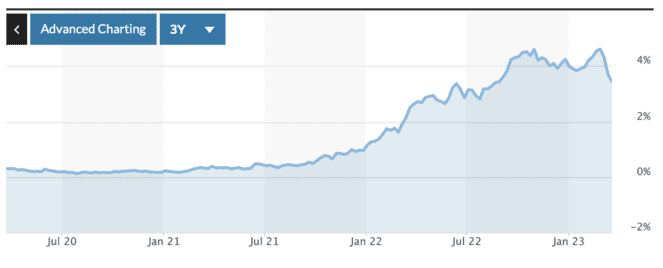
Source: MarketWatch – Yield on US 3-Year Treasury Note

It’s also worth noting that unrealised bonds losses don’t need to be included on bank results — not until they’re sold anyway. The thing is, most won’t be sold, because big banks don’t need to, and will be held until maturity.

Lloyds is a fairly middling European bank in some respect. It’s largely less exposed to risk than big US counterparts and has a strong liquidity coverage ratio of 141.8%, up from 135% at the of end-2021.

In reiterating why Lloyds looks like a solid institution right now, we can also look at the commentary. One European banking chief dismissed concerns about the sector last week, telling The FT, “We have between five to eight times as much liquidity (…) There isn’t the sector-wide sickness that was the US subprime mortgage problem of 2008”.

Buying more

I’m buying more Lloyds stock as the stock dips following the SVB fiasco. I appreciate that the current macroeconomic climate isn’t ideal because really high interest rates mean more bad debt and impairment charges. But I’m not worried about bonds.

Moreover, NII is soaring, and I’m buying with a more attractive interest rate forecast in mind. Right now, I believe this bank is considerably undervalued.


HSBC Holdings is an advertising partner of The Ascent, a Motley Fool company. James Fox has positions in Barclays Plc, HSBC Holdings, and Lloyds Banking Group Plc. The Motley Fool UK has recommended Barclays Plc, HSBC Holdings, and Lloyds Banking Group Plc. Views expressed on the companies mentioned in this article are those of the writer and therefore may differ from the official recommendations we make in our subscription services such as Share Advisor, Hidden Winners and Pro. Here at The Motley Fool we believe that considering a diverse range of insights makes us better investors.

More on Investing Articles

Woman riding her old fashioned bicycle along the Beach Esplanade at Aberdeen, Scotland.
Investing Articles

How much do you need in a Stocks and Shares ISA to generate £100 a day in passive income?

Andrew Mackie looks at what it takes to build a meaningful passive income inside a Stocks and Shares ISA and…

Read more »

Front view of a young couple walking down terraced Street in Whitley Bay in the north-east of England they are heading into the town centre and deciding which shops to go to they are also holding hands and carrying bags over their shoulders.
Investing Articles

How much second income would it take to cover household bills?

Andrew Mackie explores how a Stocks and Shares ISA could be used to generate a second income capable of covering…

Read more »

Young Caucasian man making doubtful face at camera
Investing Articles

This FTSE 100 share pays no dividends. Could that change?

This well-known FTSE 100 share is cash flow positive but does not pay a dividend. Why is that -- and…

Read more »

Two white male workmen working on site at an oil rig
Investing Articles

At almost £6, does the BP share price reflect a new energy future, or just the old oil world?

Mark Hartley examines how geopoliticals are driving the BP share price higher, while its key role in the UK’s energy…

Read more »

Portrait of pensive bearded senior looking on screen of laptop sitting at table with coffee cup.
Growth Shares

This high-risk, high-reward penny stock could be primed to rocket from 0.3p

Jon Smith talks through a mining penny stock that is high risk but could offer a big return if it…

Read more »

Girl buying groceries in the supermarket with her father.
Investing Articles

If you’d put £10,000 into Tesco shares 5 years ago, how much richer would you be now?

Ben McPoland takes a look at how much 4,444 Tesco shares bought half a decade ago would have returned, including…

Read more »

This way, That way, The other way - pointing in different directions
Investing For Beginners

My friend says this is the best cheap share in the market. Is he correct?

Jon Smith mulls a potential cheap share that could offer large returns but is a high-risk option given its recent…

Read more »

Aerial shot showing an aircraft shadow flying over an idyllic beach
Investing Articles

How much would you need to invest in FTSE 100 shares to target a £3,000 annual passive income?

Fancy thousands of pounds a year in passive income paid by blue-chip companies? Our writer explains some ins and outs…

Read more »