We have some exciting news to share! The Motley Fool UK has now become The Twelfth Magpie -- an independent, UK-owned company, led by our long-serving UK management team — Mark Rogers, Chris Nials and Heather Adlington. In practical terms, it’s the same team you know, now fully focused on serving our UK readers and members.

Just as importantly, our approach remains unchanged: long-term, jargon-free, and on your side. This site is our new home, and there will be extra tweaks made across the coming few days as we settle in. So if anything looks a little off, please bear with us!

The content of this article was relevant at the time of publishing. Circumstances change continuously and caution should therefore be exercised when relying upon any content contained within this article.

This is what I’d do about the BP share price

The BP share price gets me an 8% dividend yield and a slice of ownership in a company moving into renewables. I think BP stock might be a buy despite the risks.

| More on:

You’re reading a free article with opinions that may differ from The Twelfth Magpie’s Premium Investing Services. Become a member today to get instant access to our top analyst recommendations, in-depth research, investing resources, and more. Learn more, and get a free 'Best Buy Now' stock!.

The BP (LSE:BP) share price was 486p at the start of the year. Now it’s around 200p, almost 60% lower. The Covid-19 crisis caused oil demand to slump, and some oil-producing nations also increased their supply. This led to lower oil prices. Oil & gas producing giant BP saw its revenues slump. Losses mounted as assets were written down due to a bleak outlook for oil prices. BP had to slash its dividend and issue debt to raise cash.

The anticipation and then reality of a dividend cut explains most of BP’s share price slump. In response to the pandemic and the broader outlook for oil, it’s planning big eco-focused changes. These changes make the company riskier, explaining the rest of the share price slide. I think the BP share price is attractive at 200p because the potential rewards outweigh the risks. However, I don’t think the kind of investor it traditionally attracted would agree with me.

Should you buy Bp P.l.c. shares today?

Before you decide, please take a moment to review this report first. Despite ongoing uncertainties from US tariffs to global conflicts, Mark Rogers and his team believe many UK shares still trade at substantial discounts, offering savvy investors plenty of potential opportunities to learn about.

That’s why this could be an ideal time to secure this valuable research – Mark’s analysts have scoured the markets to reveal 5 of his favourite long-term ‘Buys’. Please, don’t make any big decisions before seeing them.

High yield, high risk

Income investors used to flock to oil majors. Oil prices, and therefore BP’s fortunes have always been cyclical. But, investors seemed to feel that the good years offset the bad enough to make the dividend reliable. Looking at the chart below, aside from the blip in the early 90s, the dividend yield on BP shares was below 5% for almost two decades as it steadily increased its dividend. That suggests the dividend was seen as reliable. Think of dividend yields like interest rates on loans: the more reliable borrower gets a lower interest rate.
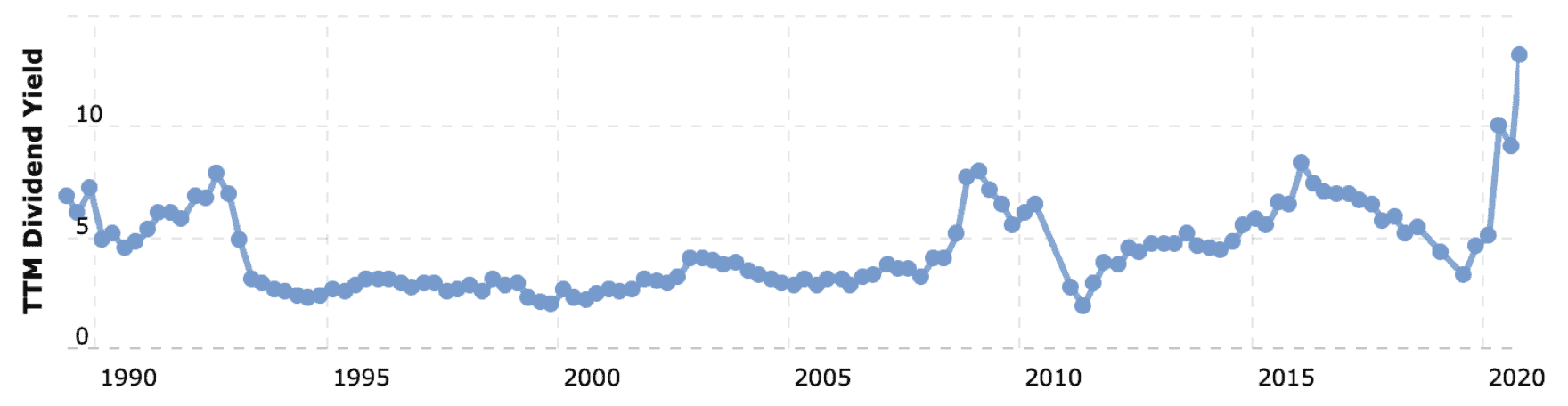
BP shares dividend yield 1990 to 2020

Source: macrotrends.net

As the Great Recession of 2007/09 unfolded, BP’s dividend yield increased, reflecting increased risk. Eventually, it cut its dividend, and the yield fell. But despite starting to increase the dividend payment again and then maintaining it all the way into 2020, the yield rose, and stayed high, only dipping below 5% briefly in late 2019. Then the Covid-19 crisis happened, and here we are.

BP has cut its dividend to 5.25 cents per share per quarter for the foreseeable future. That’s about 16p per year, or around half of what was on offer last year, but the dividend yield is around 8%. That’s high for BP, but it reflects the riskier nature of the company and its dividends. According to its own forecasts, peak oil may have already come and gone, and a renewable future looks almost certain. It has recognised this and plans to be a very different company by 2030.

Who should pay the price for BP shares?

BP has committed to a 40% reduction in oil and gas production by 2030. Investment in low carbon energy should increase from $0.5bn to $5bn annually in a decade. More renewable energy capacity, greater bioenergy production, and 10% market share for hydrogen fuel are things BP wants for its future, which includes being net-zero for emissions by 2050.

The payoffs are big if it can manage the transition. BP would swap volatile oil returns for a steady 8%-10% one on renewables projects, and markets would price its shares more favourably if it goes green. But there are significant risks involved in pivoting away from oil as you invest in what is still a young renewables industry. But I think investors who have a 10-year or so horizon, and can take the risk of missing dividend payments might find that 8% yield appealing.


James J. McCombie owns shares of BP. The Motley Fool UK has no position in any of the shares mentioned. Views expressed on the companies mentioned in this article are those of the writer and therefore may differ from the official recommendations we make in our subscription services such as Share Advisor, Hidden Winners and Pro. Here at The Motley Fool we believe that considering a diverse range of insights makes us better investors.

More on Investing Articles

Tree lined "tunnel" in the English countryside of West Sussex in autumn
Investing Articles

3 UK shares to consider holding in a Stocks and Shares ISA for a decade

Mark Hartley explains why he thinks these three stocks would make great additions to a long-term Stocks and Shares ISA…

Read more »

Hand of person putting wood cube block with word VALUE on wooden table
Investing Articles

Where should value investors look for stocks in June?

Value investors looking for stocks to buy might be uneasy with artificial intelligence. But other industries look much more attractive…

Read more »

Investing Articles

The latest broker outlooks on Greggs shares look wacky, so what’s happening?

Analyst price targets for Greggs shares are creating some mixed sentiments on where the high-street baker might go next in…

Read more »

Caerphilly Castle, and reflection in the moat.
Investing Articles

2 FTSE 100 dividend stocks that stand out for shareholder returns

Andrew Mackie highlights two FTSE 100 dividend stocks where disciplined capital allocation could continue driving shareholder returns.

Read more »

Senior Adult Black Female Tourist Admiring London
Investing Articles

Just 9% of us can expect a ‘comfortable’ retirement! Could UK shares be the answer?

Millions of Brits could miss out on the retirement of their dreams. Might they avoid this by investing in UK…

Read more »

DIVIDEND YIELD text written on a notebook with chart
Investing Articles

3 passive income shares to consider buying for a 7% yield

Harvey Jones picks out three UK income shares that offer terrific dividends and are trading at tempting valuations. None of…

Read more »

Businessman hand stacking up arrow on wooden block cubes
Investing Articles

How much just £4,160 invested in Rolls-Royce shares 5 years ago is worth now

Rolls-Royce shares have been on a remarkable run of late. Ken Hall takes a look at the key drivers and…

Read more »

Cropped shot of an affectionate young couple posing with a bunch of flowers in their kitchen on their anniversary
Investing Articles

The FTSE 100’s Howden Joinery just made a bold move — should investors care?

Andrew Mackie looks at the FTSE 100’s Howden Joinery and its move into online kitchens, asking what the acquisition means…

Read more »