We have some exciting news to share! The Motley Fool UK has now become The Twelfth Magpie -- an independent, UK-owned company, led by our long-serving UK management team — Mark Rogers, Chris Nials and Heather Adlington. In practical terms, it’s the same team you know, now fully focused on serving our UK readers and members.

Just as importantly, our approach remains unchanged: long-term, jargon-free, and on your side. This site is our new home, and there will be extra tweaks made across the coming few days as we settle in. So if anything looks a little off, please bear with us!

The content of this article was relevant at the time of publishing. Circumstances change continuously and caution should therefore be exercised when relying upon any content contained within this article.

Does buying dips in the FTSE 100 beat regular investing?

It has been said that time in the market beats trying to time the market, but is it true?

You’re reading a free article with opinions that may differ from The Twelfth Magpie’s Premium Investing Services. Become a member today to get instant access to our top analyst recommendations, in-depth research, investing resources, and more. Learn more, and get a free 'Best Buy Now' stock!.

The FTSE 100 dropped over 3% yesterday. Today it is down by another percentage point. In times like these, the question of whether buying dips in the market beats regular investing often gets asked. The answer may appear obvious. After all, buying dips means buying cheap. Regular investing could mean buying just before a dip or when the market is expensive. Should investors not aim to buy low and sell high?

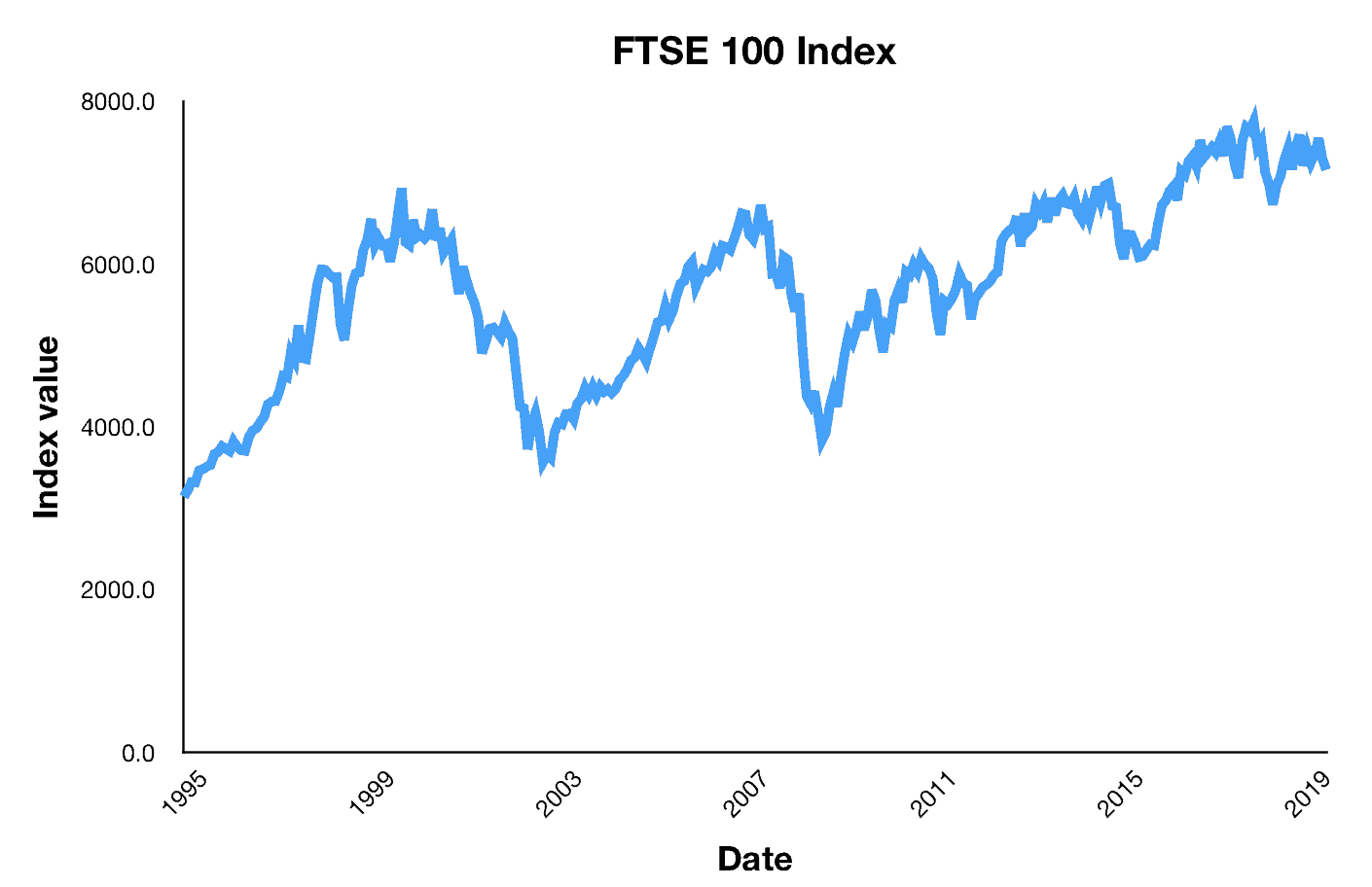
A strategy of buying low and selling high makes intuitive sense, especially when we look at the performance of the FTSE 100 index.
Should you buy Rolls Royce shares today?

Before you decide, please take a moment to review this report first. Despite ongoing uncertainties from US tariffs to global conflicts, Mark Rogers and his team believe many UK shares still trade at substantial discounts, offering savvy investors plenty of potential opportunities to learn about.

That’s why this could be an ideal time to secure this valuable research – Mark’s analysts have scoured the markets to reveal 5 of his favourite long-term ‘Buys’. Please, don’t make any big decisions before seeing them.

But the chart above shows the price of the index only. It does not account for the dividends that are paid by the companies in the index. The average annual dividend yield on the FTSE 100 from June 1993 to November 2018 was 3.47% or about 0.28% per month.

An investor in the FTSE 100 will receive these dividends if they buy all 100 stocks themselves or a fund that tracks the index. If dividends are being reinvested then the performance of the investment will not look like the chart above.

Dipping in

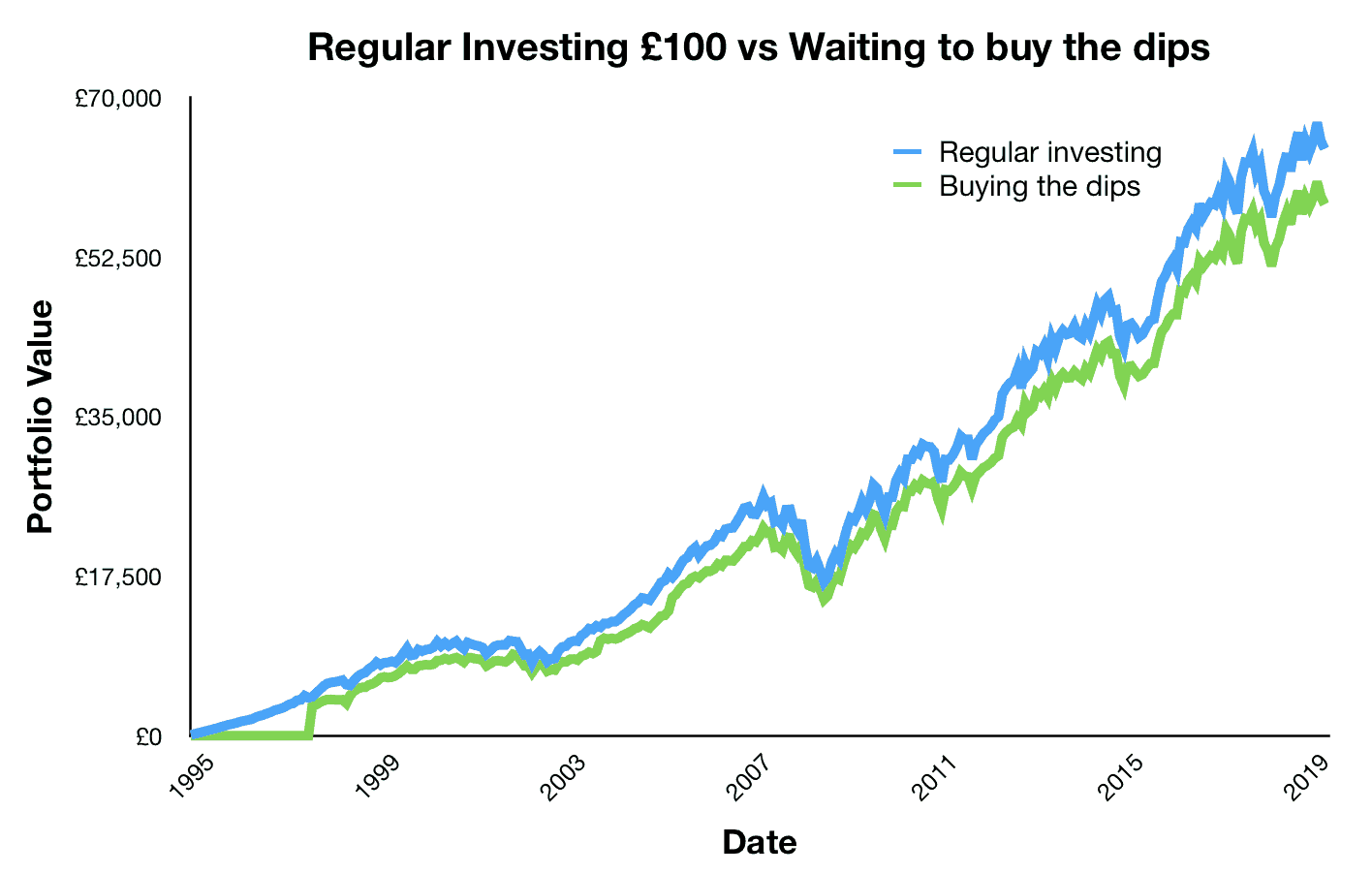
Let’s compare the two strategies. First, we will invest £100 every month in the FTSE 100 starting in March 1995 and finishing in January 2020. Second, we will look at a strategy of investing after the price of the FTSE 100 has fallen at least 5% in a month. To keep the total invested amounts similar, in the second strategy, £100 is either invested or banked until the index has fallen by 5%.

In total of £29,800 gets invested buying the dips and £30,000 in regular investments over the 25 or so years. How about the performance of the two strategies? Well, the regular investor ends up with £64,359 compared to £58,270 for the dip buyer. 
Along for the ride

Of the two strategies, regular investing comes out on top. The message is clear, don’t wait to buy the dip, just keep investing. The more time you are in the market, the more your money grows, assuming dividends are being paid and reinvested. The more you try to time the market, the less time your money has to grow.

I used data for the entire FTSE 100 for this exercise. There are some stocks that have higher dividend yields than the 3.47% average, so a diversified portfolio of those could have done even better.

Also bear in mind that this experiment was carried out with 25 years of monthly returns. The longer your investment time horizon, the more likely you are to do well. Looking back over the FTSE 100 price chart should make this point clear. If you only had two or three years to invest and you started around 1999 or 2007 you would have done badly. Long-term investing is the key to success.


Views expressed on the companies mentioned in this article are those of the writer and therefore may differ from the official recommendations we make in our subscription services such as Share Advisor, Hidden Winners and Pro. Here at The Motley Fool we believe that considering a diverse range of insights makes us better investors.

More on Investing Articles

Stack of one pound coins falling over
Investing Articles

Down 65% but yielding 6.7% – is this beaten-down UK stock now a generational bargain?

Harvey Jones says this UK stock is one of the worst FTSE 100 performers but there are sound reasons to…

Read more »

Portrait of elderly man wearing white denim shirt and glasses looking up with hand on chin. Thoughtful senior entrepreneur, studio shot against grey background.
Investing Articles

Is this FTSE stock really 46% undervalued?

Analysts reckon this FTSE stock should be worth nearly 50% more. James Beard considers why there’s so much positivity surrounding…

Read more »

Front view of a young couple walking down terraced Street in Whitley Bay in the north-east of England they are heading into the town centre and deciding which shops to go to they are also holding hands and carrying bags over their shoulders.
Investing Articles

How much is needed in an ISA for passive income that covers the UK’s monthly average rent of £1,381?

The UK’s monthly average rent for May 2026 is £1,381. Muhammad Cheema looks at how much is needed to aim…

Read more »

A rear view of a female in a bright yellow coat walking along the historic street known as The Shambles in York, UK which is a popular tourist destination in this Yorkshire city.
Investing Articles

How have BAE Systems shares become a dividend powerhouse? 5 reasons why!

Dividends on BAE Systems shares have risen every year without fail since the early 2000s. So what's the FTSE 100…

Read more »

A senior man and his wife holding hands walking up a hill on a footpath looking away from the camera at the view. The fishing village of Polperro is behind them.
Investing Articles

Want to retire early? Here’s how a weak stock market could actually help

Christopher Ruane demonstrates with a real-world example how a tumbling stock market could potentially help someone who wants to retire…

Read more »

Tanker coming in to dock in calm waters and a clear sunset
Investing Articles

BP shares: still priced as an oil major — but the market may be behind the curve

Andrew Mackie looks at BP shares and why investors may be underestimating the quality and concentration of its underlying asset…

Read more »

A rear view of a female in a bright yellow coat walking along the historic street known as The Shambles in York, UK which is a popular tourist destination in this Yorkshire city.
Investing Articles

At 8.1%, are investors missing the bigger story behind Legal & General shares?

Andrew Mackie explores Legal & General shares and asks whether investors are still viewing it too narrowly as a yield…

Read more »

Young black female footballer training on stadium pitch
Investing Articles

How has this FTSE 250 share surged ANOTHER 7% today?

Applied Nutrition shares have soared on Monday after another brilliant trading update. So what's the FTSE 250 company's secret?

Read more »