Finsbury Growth & Income Trust (LSE:FGT) is a FTSE 250 stock that I’ve become more bullish on recently. In particular, I like that manager Nick Train has significant skin in the game.
When executives or founders own a meaningful chunk of the company, their interests are aligned with shareholders. And while skin in the game alone doesn’t guarantee success, I do like to see it.
Let’s take a closer look at the stock.
The SaaS apocalypse
Finsbury Growth & Income is an investment trust with a very concentrated portfolio. Indeed, almost 52% of it is invested in Unilever, London Stock Exchange (LSEG), Sage, Experian, and RELX. And 58% is in data/software/platform companies.
The danger with this approach, of course, is that performance can really suffer if a couple of top holdings struggle. And this is what has happened, with key holdings becoming casualties of the software sell-off (aka, the SaaS apocalypse).
Here’s how four of the largest positions have performed over the past year:
- LSEG: -17.8%
- Sage: -34.4%
- Experian: -32.9%
- RELX: -37.4%
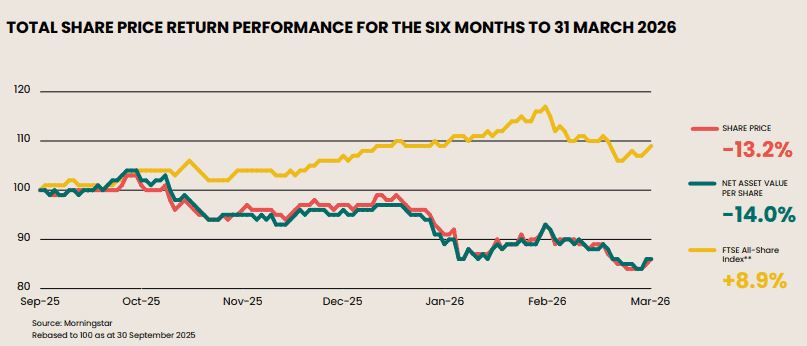
As a result, the trust’s performance has diverged massively from the FTSE All-Share Index since late 2025.
Data advantages
However, I think there’s a chance these names have been written off too quickly. Train certainly thinks so, writing recently that these tech companies “are much more likely to be beneficiaries from AI than victims of it“.
The reason? Proprietary business data that is “constantly replenishing“. This, Train argues, is something that “AI models would love to get their hands on“.
The numbers the manager cites are certainly mind-boggling. Experian’s confidential data on millions of individuals and businesses worldwide is updated a billion times every month, while RELX’s risk division handles 450m identity checks a day.
Meanwhile, LSEG’S price updates and data points grow at a rate of 15m new messages every second. The firm is actively licensing its data to AI firms.
As for Sage, which provides accounting and tax compliance software, it’s seeing growth from new AI tools and services. CEO Steve Hare has dismissed the notion that general AI will replace CFOs and accountants, calling it “ludicrous“.
Beyond data platforms, Finsbury also has big positions in Diageo and Burberry. Both have recently shown early signs of a potential recovery, albeit the macroeconomic conditions remain very challenging.
How much income is on offer?
I believe an alignment of interest between investment manager and investor is important.
Nick Train
Train has been snapping up shares over the past couple of years, lifting his stake to 5.6% in April. That’s unusually high for an investment trust.
It’s also worth noting that Finsbury is raising its dividend significantly. From October, the payout will increase by at least 50% to about 30p per share.
At the current price of 738p, this translates into a forward-looking dividend yield of 4%.
Finally, the shares are trading at a near-7% discount to underlying assets. For investors who think FTSE 100 data/software companies mentioned above will benefit from AI rather be destroyed by it, Finsbury stock is worth a closer look right now.
A 7% discount and 4% dividend yield certainly sweeten the investment case.
Should you invest £5,000 in Finsbury Growth & Income Trust Plc right now?
When investing expert Mark Rogers and his team have a stock tip, it can pay to listen. After all, the flagship Twelfth Magpie Share Advisor newsletter he has run for nearly a decade has provided thousands of paying members with top stock recommendations from the UK and US markets.
And right now, Mark thinks there are 6 standout stocks that investors should consider buying. Want to see if Finsbury Growth & Income Trust Plc made the list?
Ben McPoland owns shares in Diageo and Sage.