Many investors focus on contributions and tax relief when it comes to SIPPs. But those may not be the factors that ultimately drive long-term wealth creation. Instead, the real advantage of a SIPP often comes from something far less discussed — and far more powerful over time.
Please note that tax treatment depends on the individual circumstances of each client and may be subject to change in future. The content in this article is provided for information purposes only. It is not intended to be, neither does it constitute, any form of tax advice. Readers are responsible for carrying out their own due diligence and for obtaining professional advice before making any investment decisions.
What really matters
Most investors think of a SIPP as a retirement account. Somewhere to save for later life and eventually draw an income.
But that framing can miss the bigger picture.
A SIPP is not defined by the pension wrapper itself. What matters far more is what sits inside it — and how long those investments are allowed to compound.
Over long periods, time often becomes the most powerful force. Earlier gains begin generating returns of their own, gradually shifting wealth creation away from fresh contributions and towards growth created by the portfolio itself.
That is where the real power of a SIPP begins to emerge.
When money starts working harder
To explore this idea, I modelled an investor with a £30,000 starting SIPP alongside regular yearly contributions over a 20-year period.
What stands out in the chart is not simply the final value, but how wealth creation gradually changes shape.
During the early years, contributions remain the dominant driver. But as gains begin generating returns of their own, compounding contributes an increasingly large share of total wealth.
That is where long-term investing starts to look different. Over time, growth generated by the portfolio can rival — and eventually exceed — the impact of fresh money being added.
The lesson is simple: a SIPP is not merely a pension account. Given enough time, it can become a compounding machine.
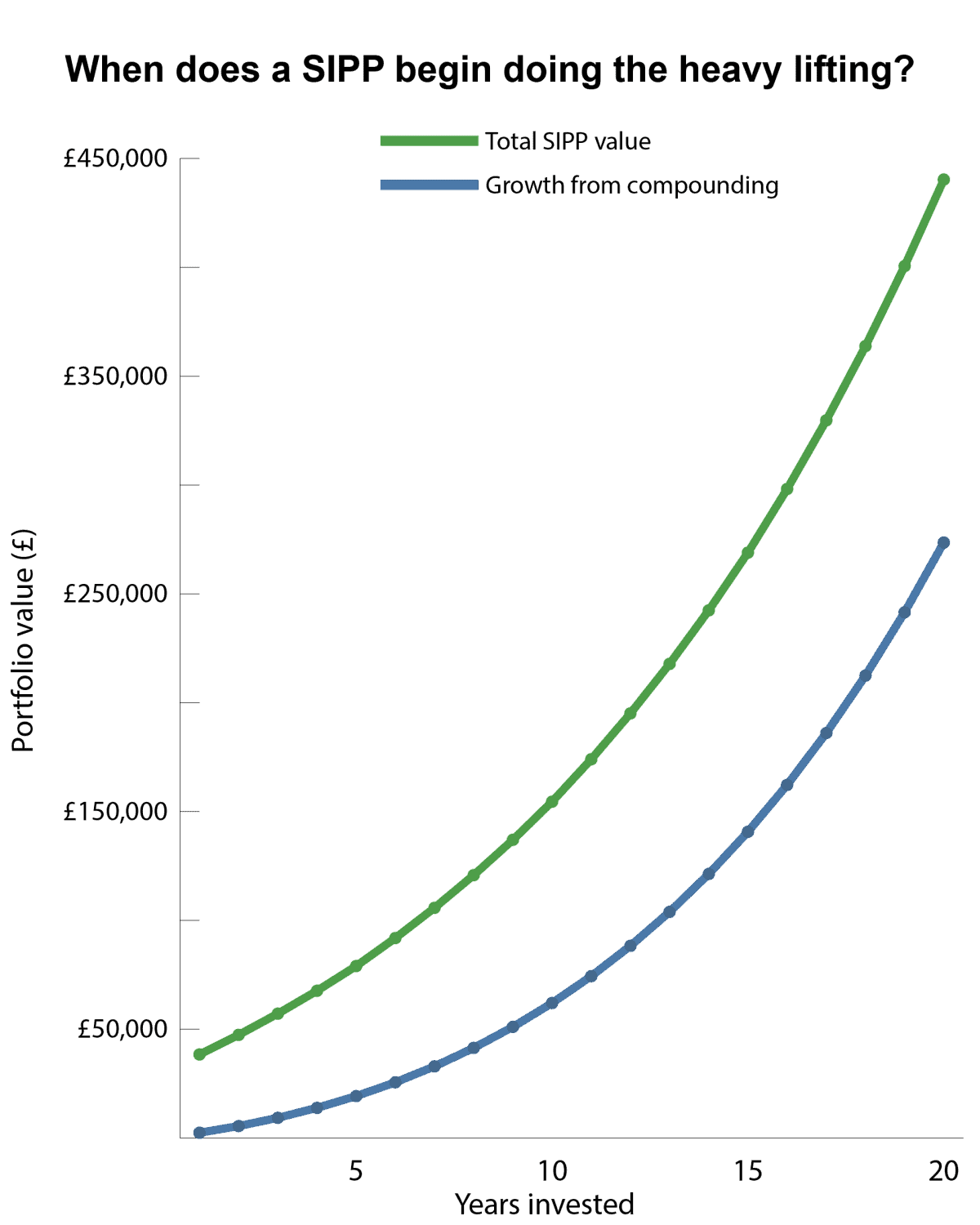
Chart generated by author
Quiet compounder
Take Halma (LSE: HLMA) as an example. It may not generate the headlines of fast-growing technology stocks, but few FTSE 100 companies better illustrate the power of long-term compounding.
The group operates a decentralised model across safety, environmental, and healthcare technologies. That sounds broad, but the common thread is important: it focuses on specialist niches with resilient demand, high barriers to entry, and often regulation-driven growth.
What stands out to me is how management thinks. Rather than chasing short-term cycles, the business is built around what it calls a “Sustainable Growth Model”. This combines long-term thinking with enough flexibility for its individual businesses to adapt quickly as markets evolve.
That matters because many of Halma’s end markets are supported by trends unlikely to disappear anytime soon. Clean water, healthcare, industrial safety, and data infrastructure are not temporary themes. They are long-duration challenges that increasingly require specialist technology.
Its decentralised structure also gives individual businesses the freedom to innovate and respond quickly to changing customer demand, while the wider group provides financial discipline and acquisition expertise.
Of course, quality rarely comes cheaply. Today, Halma trades on a trailing price-to-earnings ratio of around 50, leaving little room for disappointment if growth slows. Its acquisition-led model also relies on disciplined execution, meaning poor integration or overpaying for deals could pressure future returns.
But for SIPP investors, that may not be the main point.
The earlier chart showed how powerful compounding becomes when given enough time. To me, Halma represents the same principle in stock form — a business designed to compound steadily over decades rather than chase short-term excitement.
Should you invest £5,000 in Halma Plc right now?
When investing expert Mark Rogers and his team have a stock tip, it can pay to listen. After all, the flagship Twelfth Magpie Share Advisor newsletter he has run for nearly a decade has provided thousands of paying members with top stock recommendations from the UK and US markets.
And right now, Mark thinks there are 6 standout stocks that investors should consider buying. Want to see if Halma Plc made the list?
Andrew Mackie does not hold any positions in the companies mentioned.