We have some exciting news to share! The Motley Fool UK has now become The Twelfth Magpie -- an independent, UK-owned company, led by our long-serving UK management team — Mark Rogers, Chris Nials and Heather Adlington. In practical terms, it’s the same team you know, now fully focused on serving our UK readers and members.

Just as importantly, our approach remains unchanged: long-term, jargon-free, and on your side. This site is our new home, and there will be extra tweaks made across the coming few days as we settle in. So if anything looks a little off, please bear with us!

The content of this article was relevant at the time of publishing. Circumstances change continuously and caution should therefore be exercised when relying upon any content contained within this article.

Be ready for a savage stock market crash

An AI thought experiment has sent shockwaves through the stock market. How worried should we all be by this doomsday vision?

| More on:
Middle-aged white man pulling an aggrieved face while looking at a screen

Image source: Getty Images

You’re reading a free article with opinions that may differ from The Twelfth Magpie’s Premium Investing Services. Become a member today to get instant access to our top analyst recommendations, in-depth research, investing resources, and more. Learn more, and get a free 'Best Buy Now' stock!.

Some writers here at The Motley Fool have been worrying about an AI-driven stock market crash. And it seems others are waking up to the risk because an AI doomsday Substack post has gone viral this week.

The post from Citrini Research even caused a number of stocks mentioned to drop sharply on Monday (23 February). These included DoorDash, American Express, and (fittingly) Monday.com.

Should you buy AstraZeneca Plc shares today?

Before you decide, please take a moment to review this report first. Despite ongoing uncertainties from US tariffs to global conflicts, Mark Rogers and his team believe many UK shares still trade at substantial discounts, offering savvy investors plenty of potential opportunities to learn about.

That’s why this could be an ideal time to secure this valuable research – Mark’s analysts have scoured the markets to reveal 5 of his favourite long-term ‘Buys’. Please, don’t make any big decisions before seeing them.

What did this post say? And how worried should we be?

The AI revolution is paradoxical

The lengthy post in question — entitled The 2028 Global Intelligence Crisis — describes a fictional future where AI rapidly displaces human labour.

A negative feedback loop emerges where companies, facing margin pressure, replace white-collar workers with AI. This soon reduces consumer spending, leading to further layoffs. 

Meanwhile, autonomous AI agents do more tasks for consumers (insurance renewals, travel booking, shopping, etc). Unlike humans, AI agents aren’t loyal to apps like Uber or Booking, so a huge amount of enterprise value is destroyed.

The S&P 500 starts crashing.

Jobs become harder to find and the crisis threatens the $13trn residential US mortgage market as white-collar incomes vanish. 

The paradox here is that this scary scenario is only possible if AI truly succeeds, not fails.
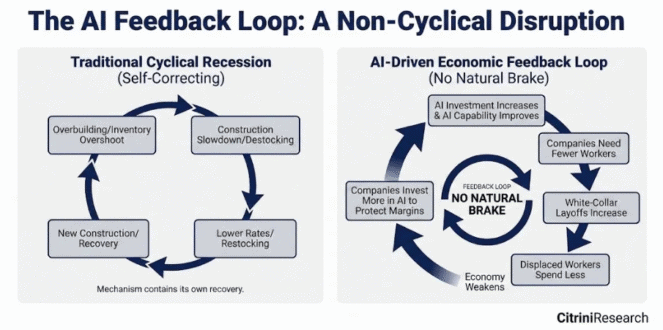
Source: Citrini Research

Some perspective

As alarming as all this sounds, it’s important to remember this is just an imagined scenario/warning, not a prediction.

Second, the 2028 timeframe is deliberately provocative. There’s no conclusive evidence AI is causing massive layoffs, while the physical AI buildout is creating jobs. So the economy appears in no immediate danger.

Moreover, elected governments are not passive observers. If unemployment were to rapidly reach the 10%+ described in the Citrini piece, we would likely see regulatory intervention to slow the pace of AI deployment.

Further down the line, measures like Universal Basic Income or job-retraining programmes could be funded by AI productivity taxes.

Today, generative AI still hallucinates. In regulated industries (finance, law, medicine, etc), a human with the proper authority still has to sign off.

Finally, nobody can predict exactly when a crash will happen.

Diversification

But we should at all times be ready for a big crash, whether it’s generated by AI, a pandemic, a financial crisis or something else. As I see it, there are there basic things we can do to prepare for the worst:

This last part is crucial. In my portfolio, I hold AstraZeneca (LSE:AZN). To my mind, the pharma giant looks more likely to benefit from the technology than be disrupted by it.

AI drug discovery, for example, should significantly increase the chances of a drug candidate succeeding in trials, as well as lowering costs and boosting margins. The firm is already leaning heavily into the technology in research and development.

Admittedly, a forward earnings multiple of 19 isn’t cheap. If the company’s growth unexpectedly slows, the stock could sell off.

On balance, however, I’m bullish on AstraZeneca moving forward. It now has 16 blockbuster medicines (those generating at least $1bn in annual sales).

By 2030, it’s aiming for $80bn in revenue, up from $58.7bn last year, driven by its massive pipeline and valuable oncology portfolio. 

I think AstraZeneca is worth considering today for a diversified Stocks and Shares ISA.

American Express is an advertising partner of Motley Fool Money. Ben McPoland has positions in AstraZeneca Plc and Uber Technologies. The Motley Fool UK has recommended AstraZeneca Plc and Uber Technologies. Views expressed on the companies mentioned in this article are those of the writer and therefore may differ from the official recommendations we make in our subscription services such as Share Advisor, Hidden Winners and Pro. Here at The Motley Fool we believe that considering a diverse range of insights makes us better investors.

More on Investing Articles

Young female couple boarding their plane at the airport to go on holiday.
Investing Articles

Can the Rolls-Royce share price reach £15.97 by the end of August?

The Rolls-Royce share price has had a solid run in the last year. Muhammad Cheema takes a look at whether…

Read more »

Santa Clara offices of NVIDIA
Investing Articles

Up 1,200% in 5 years, here’s why Nvidia could still be a brilliant value stock

An exciting new announcement that could reshape the PC industry has just pushed Nvidia stock... well, just about nowhere really.

Read more »

House models and one with REIT - standing for real estate investment trust - written on it.
Investing Articles

How investing £4.50 a day could set you on the way to a £1,505 monthly second income

How can UK stocks with high dividend yields help investors earn a meaningful second income from the price of a…

Read more »

Investing Articles

Up 103% with a P/E of 261 — is this FTSE 100 stock still worth buying?

One FTSE 100 stock is quietly moving higher while most investors are still looking elsewhere — is the market missing…

Read more »

Concept of two young professional men looking at a screen in a technological data centre
Investing Articles

The smart money thinks AI stocks look risky — but is there still a chance to buy?

According to fund managers, the AI trade is getting crowded. But they still seem to think it’s the place to…

Read more »

Man putting his card into an ATM machine while his son sits in a stroller beside him.
Investing Articles

Barclays shares are 11% below their 52-week high. Could they be a bit of a bargain to consider?

Overpriced or one of the FTSE 100’s hidden gems? James Beard takes a closer look at how the market is…

Read more »

Stack of one pound coins falling over
Investing Articles

Down 65% but yielding 6.7% – is this beaten-down UK stock now a generational bargain?

Harvey Jones says this UK stock is one of the worst FTSE 100 performers but there are sound reasons to…

Read more »

Portrait of elderly man wearing white denim shirt and glasses looking up with hand on chin. Thoughtful senior entrepreneur, studio shot against grey background.
Investing Articles

Is this FTSE stock really 46% undervalued?

Analysts reckon this FTSE stock should be worth nearly 50% more. James Beard considers why there’s so much positivity surrounding…

Read more »