We have some exciting news to share! The Motley Fool UK has now become The Twelfth Magpie -- an independent, UK-owned company, led by our long-serving UK management team — Mark Rogers, Chris Nials and Heather Adlington. In practical terms, it’s the same team you know, now fully focused on serving our UK readers and members.

Just as importantly, our approach remains unchanged: long-term, jargon-free, and on your side. This site is our new home, and there will be extra tweaks made across the coming few days as we settle in. So if anything looks a little off, please bear with us!

The content of this article was relevant at the time of publishing. Circumstances change continuously and caution should therefore be exercised when relying upon any content contained within this article.

How much do you need in an ISA to earn a £20,000 second income?

Dr James Fox details how investors can use a Stocks and Shares ISA to build a second income. It’s not rocket science, it’s all about patience.

| More on:
Businessman hand stacking money coins with virtual percentage icons

Image source: Getty Images

You’re reading a free article with opinions that may differ from The Twelfth Magpie’s Premium Investing Services. Become a member today to get instant access to our top analyst recommendations, in-depth research, investing resources, and more. Learn more, and get a free 'Best Buy Now' stock!.

A £20,000 second income is a great target for many novice investors. It represents the point at which an ISA stops feeling like a savings vehicle and starts looking more like a meaningful income stream — one that can supplement work, fund early retirement, or simply provide financial breathing space.

And let’s put it into perspective: this is £20,000 without any taxation. That’s because there’s no capital gains, dividend, or income tax on the Stocks and Shares ISA. It’s the equivalent of working in a job and earning a before-tax salary of £23,500 a year.

Should you buy Scottish Mortgage Investment Trust Plc shares today?

Before you decide, please take a moment to review this report first. Despite ongoing uncertainties from US tariffs to global conflicts, Mark Rogers and his team believe many UK shares still trade at substantial discounts, offering savvy investors plenty of potential opportunities to learn about.

That’s why this could be an ideal time to secure this valuable research – Mark’s analysts have scoured the markets to reveal 5 of his favourite long-term ‘Buys’. Please, don’t make any big decisions before seeing them.

Making it a reality

The obvious question is how big does an ISA need to be to make that happen? In simple terms, it comes down to yield. An ISA producing a dependable 4% annual income would need to be worth around £500,000 to generate £20,000 a year. That might sound like a daunting figure, but it’s entirely achievable.

Push the yield higher and the required pot shrinks. At 6%, the same income could be generated from closer to £330,000. At 7%, it drops below £300,000.

The catch, of course, is that higher yields rarely come without higher risk. Dividends can be cut, share prices can fall, and income that looks generous on paper can prove unreliable in tougher markets.

That’s why the real challenge isn’t hitting £20,000 once — it’s making sure the income lasts.

Please note that tax treatment depends on the individual circumstances of each client and may be subject to change in future. The content in this article is provided for information purposes only. It is not intended to be, neither does it constitute, any form of tax advice. Readers are responsible for carrying out their own due diligence and for obtaining professional advice before making any investment decisions.

Building the portfolio

The average growth rates of Stocks and Shares ISA in the UK in recent years is nearly 10%. That’s actually quite impressive, but good investors can far exceed that.

Below, we can see how £750 a month could compound over 20 years, assuming a 10% annualised return. That £500,000 could be reached in 19 years.
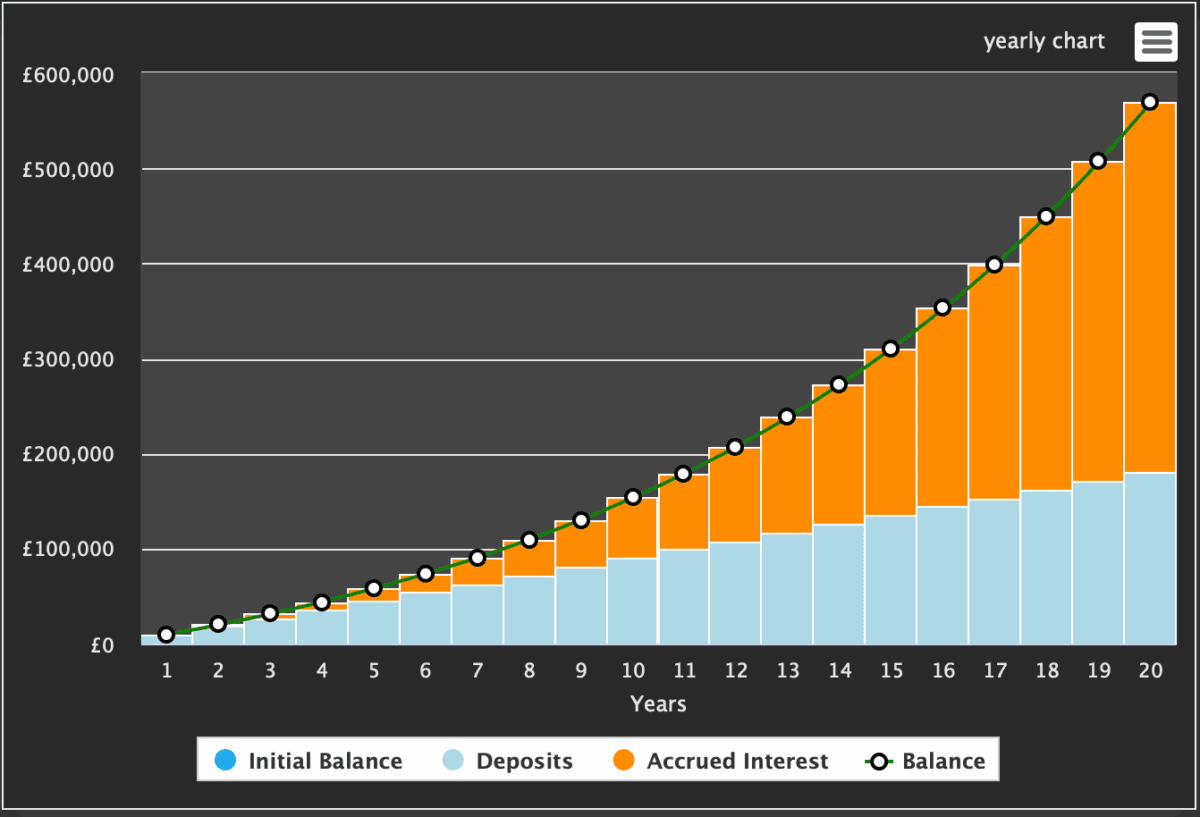
Source: thecalculatorsite.com

Great in theory

The theory here’s great, but you’ve got to know where to invest. That’s because poor investment decisions can lose money.

So where to invest to build the portfolio? Well, one stock I believe’s well worth considering is Scottish Mortgage Investment Trust (LSE:SMT). Those of you more familiar with investing might think it’s a bit of a cop out to pick an investment trust. But in this case, that misses the point.

The trust offers exposure to a concentrated portfolio of high-quality growth companies, many of which would be difficult for most individual investors to access directly. This includes SpaceX, which represented 15.2% of the portfolio.

Actually, this SpaceX exposure is one of the reasons I’m so bullish on the trust. I’d assume this holding percentage reflects the latest reported valuation for the Elon Musk company, which is $800bn. But there’s talk of SpaceX going public next year with a valuation of $1.5trn. All things being equal, that would drastically increase the net asset value of the trust.

But it’s also interesting because of its track record. The trust has a great track record for picking the next big winners.

Risks include leverage, as the trust borrows to invest. Not a huge amount, but this can amplify losses if the value of its investments fall.

Nonetheless, there’s a lot to like about the portfolio. It’s a core part of my pension and a smallish part of my ISA.


James Fox has positions in Scottish Mortgage Investment Trust Plc. The Motley Fool UK has no position in any of the shares mentioned. Views expressed on the companies mentioned in this article are those of the writer and therefore may differ from the official recommendations we make in our subscription services such as Share Advisor, Hidden Winners and Pro. Here at The Motley Fool we believe that considering a diverse range of insights makes us better investors.

More on Investing Articles

Young female couple boarding their plane at the airport to go on holiday.
Investing Articles

Can the Rolls-Royce share price reach £15.97 by the end of August?

The Rolls-Royce share price has had a solid run in the last year. Muhammad Cheema takes a look at whether…

Read more »

Santa Clara offices of NVIDIA
Investing Articles

Up 1,200% in 5 years, here’s why Nvidia could still be a brilliant value stock

An exciting new announcement that could reshape the PC industry has just pushed Nvidia stock... well, just about nowhere really.

Read more »

House models and one with REIT - standing for real estate investment trust - written on it.
Investing Articles

How investing £4.50 a day could set you on the way to a £1,505 monthly second income

How can UK stocks with high dividend yields help investors earn a meaningful second income from the price of a…

Read more »

Investing Articles

Up 103% with a P/E of 261 — is this FTSE 100 stock still worth buying?

One FTSE 100 stock is quietly moving higher while most investors are still looking elsewhere — is the market missing…

Read more »

Concept of two young professional men looking at a screen in a technological data centre
Investing Articles

The smart money thinks AI stocks look risky — but is there still a chance to buy?

According to fund managers, the AI trade is getting crowded. But they still seem to think it’s the place to…

Read more »

Man putting his card into an ATM machine while his son sits in a stroller beside him.
Investing Articles

Barclays shares are 11% below their 52-week high. Could they be a bit of a bargain to consider?

Overpriced or one of the FTSE 100’s hidden gems? James Beard takes a closer look at how the market is…

Read more »

Stack of one pound coins falling over
Investing Articles

Down 65% but yielding 6.7% – is this beaten-down UK stock now a generational bargain?

Harvey Jones says this UK stock is one of the worst FTSE 100 performers but there are sound reasons to…

Read more »

Portrait of elderly man wearing white denim shirt and glasses looking up with hand on chin. Thoughtful senior entrepreneur, studio shot against grey background.
Investing Articles

Is this FTSE stock really 46% undervalued?

Analysts reckon this FTSE stock should be worth nearly 50% more. James Beard considers why there’s so much positivity surrounding…

Read more »