We have some exciting news to share! The Motley Fool UK has now become The Twelfth Magpie -- an independent, UK-owned company, led by our long-serving UK management team — Mark Rogers, Chris Nials and Heather Adlington. In practical terms, it’s the same team you know, now fully focused on serving our UK readers and members.

Just as importantly, our approach remains unchanged: long-term, jargon-free, and on your side. This site is our new home, and there will be extra tweaks made across the coming few days as we settle in. So if anything looks a little off, please bear with us!

The content of this article was relevant at the time of publishing. Circumstances change continuously and caution should therefore be exercised when relying upon any content contained within this article.

Could a £250K ISA replace your salary? The numbers are revealing

Is a £250,000 Stocks and Shares ISA enough? This writer crunches the numbers and reveals why balancing growth and income really matters.

| More on:
Friends at the bay near the village of Diabaig on the side of Loch Torridon in Wester Ross, Scotland. They are taking a break from their bike ride to relax and chat. They are laughing together.

Image source: Getty Images

You’re reading a free article with opinions that may differ from The Twelfth Magpie’s Premium Investing Services. Become a member today to get instant access to our top analyst recommendations, in-depth research, investing resources, and more. Learn more, and get a free 'Best Buy Now' stock!.

A £250,000 ISA sounds like a major financial milestone. But when it comes to replacing a salary, the reality is far more sobering than it first appears.

Sustainable income

Once contributions stop, the focus shifts from growth to sustainable income. That requires an understanding of how withdrawals, longevity, and inflation interact during the drawdown phase.

Should you buy Aviva Plc shares today?

Before you decide, please take a moment to review this report first. Despite ongoing uncertainties from US tariffs to global conflicts, Mark Rogers and his team believe many UK shares still trade at substantial discounts, offering savvy investors plenty of potential opportunities to learn about.

That’s why this could be an ideal time to secure this valuable research – Mark’s analysts have scoured the markets to reveal 5 of his favourite long-term ‘Buys’. Please, don’t make any big decisions before seeing them.

The chart below assumes a cautious long-term return of 4% a year and inflation of 2% during drawdown. By running the portfolio down to zero by age 85, it effectively stress-tests the maximum sustainable income over a 20-year retirement.
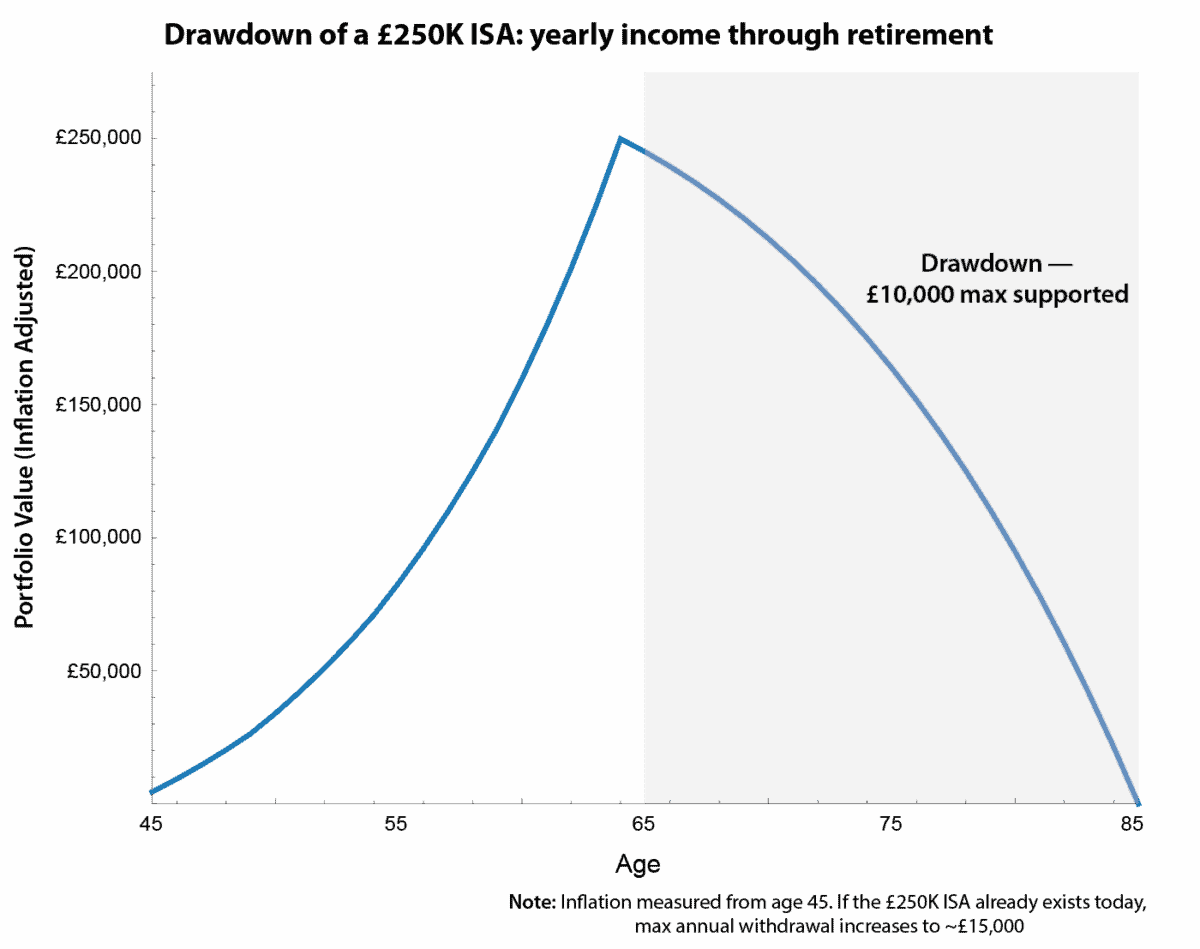
stress testing a £250,000 ISA during drawdown

Chart generated by author

Under these assumptions, a £250,000 ISA can generate around £10,000 a year, or roughly £833 per month, in inflation-adjusted income. That may cover some essentials or supplement other income, but it falls well short of replacing a typical salary.

Allowing for market volatility or longer life expectancy reduces sustainable income to around £750 per month, while leaving a residual balance of roughly £57,000.

Inflation timing

For investors who already hold the full £250,000 today, the inflation ‘clock’ starts now. In this scenario, the same modelling assumptions could support income closer to £15,000 a year, or about £1,250 per month.

This shows how prior accumulation improves flexibility. Even so, it still represents partial salary replacement rather than full financial independence.

The message is clear: a £250,000 ISA is a solid foundation, but not life-changing on its own. Its value lies in flexibility – supporting spending and supplementing pensions – rather than fully replacing earned income.

Growth and income

Few stocks are suited to both building an ISA and drawing income from it later, but Aviva (LSE: AV.) is one that deserves a closer look.

Its share price rose 42% in 2025, underlining its growth credentials. Supporting that performance has been an ongoing shift towards a capital-light business model, which has improved returns and cash generation.

The buyout of general insurance rival Direct Line at the end of last year should help accelerate this trend. By 2028, it’s targeting more than 75% of operating profit to come from capital-light divisions.

But there’s more to the business than Direct Line. The partnership with Nationwide Building Society has proved to be a winner, attracting new business and strengthening distribution. Meanwhile, in Commercial Lines, the successful integration of Probitas has given the company access to the lucrative Lloyd’s insurance market.

Dividends

The company’s strong share price performance has pushed the dividend yield lower. Even so, at a trailing yield of 5.2%, it remains comfortably ahead of the FTSE 100 average.

In the last financial year, dividend cover was just 0.66 times, meaning reported earnings did not fully cover the payout. That doesn’t overly concern me, as traditional accounting metrics can be misleading when assessing insurance businesses with complex capital structures.

Of greater concern is Aviva’s large corporate bond portfolio. If companies continue to struggle in a weak economic environment, default rates could rise, weighing on investment returns and, in turn, dividend sustainability.

Bottom line

Aviva is a stock with clear momentum. With management setting ambitious new three-year targets, including 11% annual EPS growth, I believe it has the potential to support both earnings growth and a rising dividend as I work towards a £250,000 ISA myself.


Andrew Mackie has positions in Aviva Plc. The Motley Fool UK has no position in any of the shares mentioned. Views expressed on the companies mentioned in this article are those of the writer and therefore may differ from the official recommendations we make in our subscription services such as Share Advisor, Hidden Winners and Pro. Here at The Motley Fool we believe that considering a diverse range of insights makes us better investors.

More on Investing Articles

Close-up of British bank notes
Investing Articles

How are these FTSE 100 and FTSE 250 dividend stocks so cheap?!

Discover which FTSE 100 and FTSE 250 dividend stocks Royston Wild thinks are trading under value -- including a top-quality…

Read more »

Front view photo of a woman using digital tablet in London
Value Shares

How has Sage become one of the FTSE 100’s best bargain shares?

Sales and profits keep growing at double-digit rates. So why are Sage's share struggling? Royston Wild discusses this FTSE share.

Read more »

Young female couple boarding their plane at the airport to go on holiday.
Investing Articles

Can the Rolls-Royce share price reach £15.97 by the end of August?

The Rolls-Royce share price has had a solid run in the last year. Muhammad Cheema takes a look at whether…

Read more »

Santa Clara offices of NVIDIA
Investing Articles

Up 1,200% in 5 years, here’s why Nvidia could still be a brilliant value stock

An exciting new announcement that could reshape the PC industry has just pushed Nvidia stock... well, just about nowhere really.

Read more »

House models and one with REIT - standing for real estate investment trust - written on it.
Investing Articles

How investing £4.50 a day could set you on the way to a £1,505 monthly second income

How can UK stocks with high dividend yields help investors earn a meaningful second income from the price of a…

Read more »

Investing Articles

Up 103% with a P/E of 261 — is this FTSE 100 stock still worth buying?

One FTSE 100 stock is quietly moving higher while most investors are still looking elsewhere — is the market missing…

Read more »

Concept of two young professional men looking at a screen in a technological data centre
Investing Articles

The smart money thinks AI stocks look risky — but is there still a chance to buy?

According to fund managers, the AI trade is getting crowded. But they still seem to think it’s the place to…

Read more »

Man putting his card into an ATM machine while his son sits in a stroller beside him.
Investing Articles

Barclays shares are 11% below their 52-week high. Could they be a bit of a bargain to consider?

Overpriced or one of the FTSE 100’s hidden gems? James Beard takes a closer look at how the market is…

Read more »