We have some exciting news to share! The Motley Fool UK has now become The Twelfth Magpie -- an independent, UK-owned company, led by our long-serving UK management team — Mark Rogers, Chris Nials and Heather Adlington. In practical terms, it’s the same team you know, now fully focused on serving our UK readers and members.

Just as importantly, our approach remains unchanged: long-term, jargon-free, and on your side. This site is our new home, and there will be extra tweaks made across the coming few days as we settle in. So if anything looks a little off, please bear with us!

The content of this article was relevant at the time of publishing. Circumstances change continuously and caution should therefore be exercised when relying upon any content contained within this article.

With no savings at 30, here’s how an investor can work towards a huge passive income portfolio

Consistency is key, and it can certainly pay to start contributing to an ISA sooner rather than later in the pursuit of passive income.

| More on:
Young black colleagues high-fiving each other at work

Image source: Getty Images

You’re reading a free article with opinions that may differ from The Twelfth Magpie’s Premium Investing Services. Become a member today to get instant access to our top analyst recommendations, in-depth research, investing resources, and more. Learn more, and get a free 'Best Buy Now' stock!.

Millions of us invest for passive income. However, most don’t know where to start. That’s especially the case for those of us without anything saved.

So where does an investor begin, especially with no nest egg at age 30? The answer, as ever, is deceptively simple. Start putting aside a portion of salary each month.

Should you buy Lloyds Banking Group Plc shares today?

Before you decide, please take a moment to review this report first. Despite ongoing uncertainties from US tariffs to global conflicts, Mark Rogers and his team believe many UK shares still trade at substantial discounts, offering savvy investors plenty of potential opportunities to learn about.

That’s why this could be an ideal time to secure this valuable research – Mark’s analysts have scoured the markets to reveal 5 of his favourite long-term ‘Buys’. Please, don’t make any big decisions before seeing them.

Even if the amount feels modest at first — perhaps £100 or £200, whatever is manageable — the key is consistency. By treating savings as a non-negotiable expense, akin to rent or council tax, a foundation’s created for a future portfolio that works independently.

Compounding magic

But here’s the real magic: compounding. This is the quiet force that transforms small, regular investments into substantial wealth over time. And that’s important. Because we need substantial wealth in order to earn a passive income.

For example, if £200 is invested each month from age 30, and an average annual return of 5% is achieved, by age 65 the resulting pot could be well into six figures. However, more successful investors may be able to average double-digit returns over the period.

As we can see from the below chart, £200 a month could compound into nearly £800,000 with 10% annualised growth (which not everyone will be able to achieve).
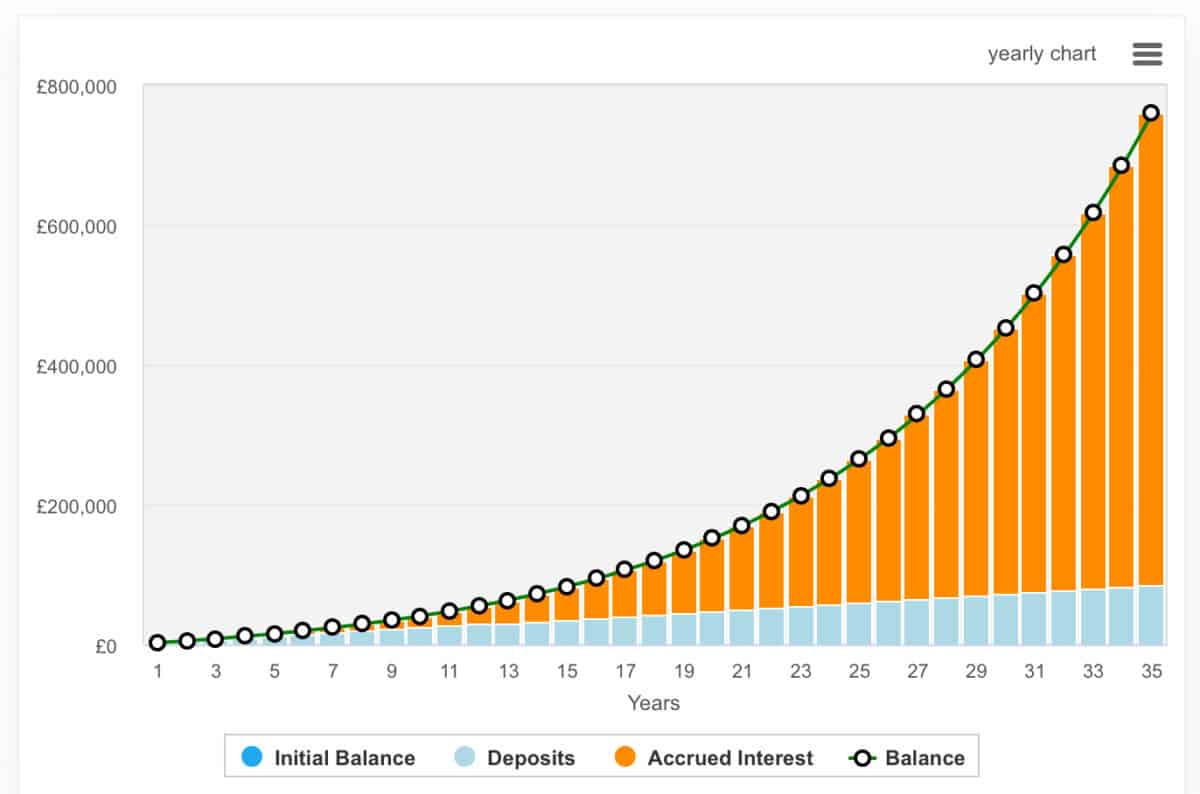
Souce: thecalculatorsite.com

The earlier the start, the more powerful compounding becomes. Consider two hypothetical investors: one begins at 30, the other waits until 40 but doubles the monthly contribution. Despite putting in more money, the late starter’s unlikely to catch up, simply because the early bird’s money has had more time to snowball.

Reinvesting dividends is another crucial lever. Rather than taking payouts as cash, dividends need to be ploughed back into holdings. This creates a virtuous cycle that accelerates growth.

Above all, patience is the greatest ally. The urge to tinker or chase fads can be ignored. Time and compounding do the heavy lifting.

Where to invest?

Let’s be practical and not assume a 10% return. One option that could be considered as part of a diverse portfolio over the next 35 years is Lloyds (LSE:LLOY). The British lender offers a blend of income and value for investors seeking exposure to the banking sector. Despite recent volatility, including the motor finance mis-selling probe, Lloyds is resilient with strong capital buffers and a progressive dividend policy.


Looking ahead, Lloyds’ forward earnings are forecast to improve. Earnings per share (EPS) are projected at 6.5p in 2025, rising to 8.85p in 2026 and 10.68p in 2027.

As such, the forward price-to-earnings (P/E) ratio’s expected to decline from 10.9 times in 2025 to 8 times in 2026 and 6.6 times in 2027. Dividends are also set to grow, with forecasts of 3.44p per share in 2025, 4.07p in 2026, and 4.64p in 2027, translating to yields between 4.9% and 6.6%.
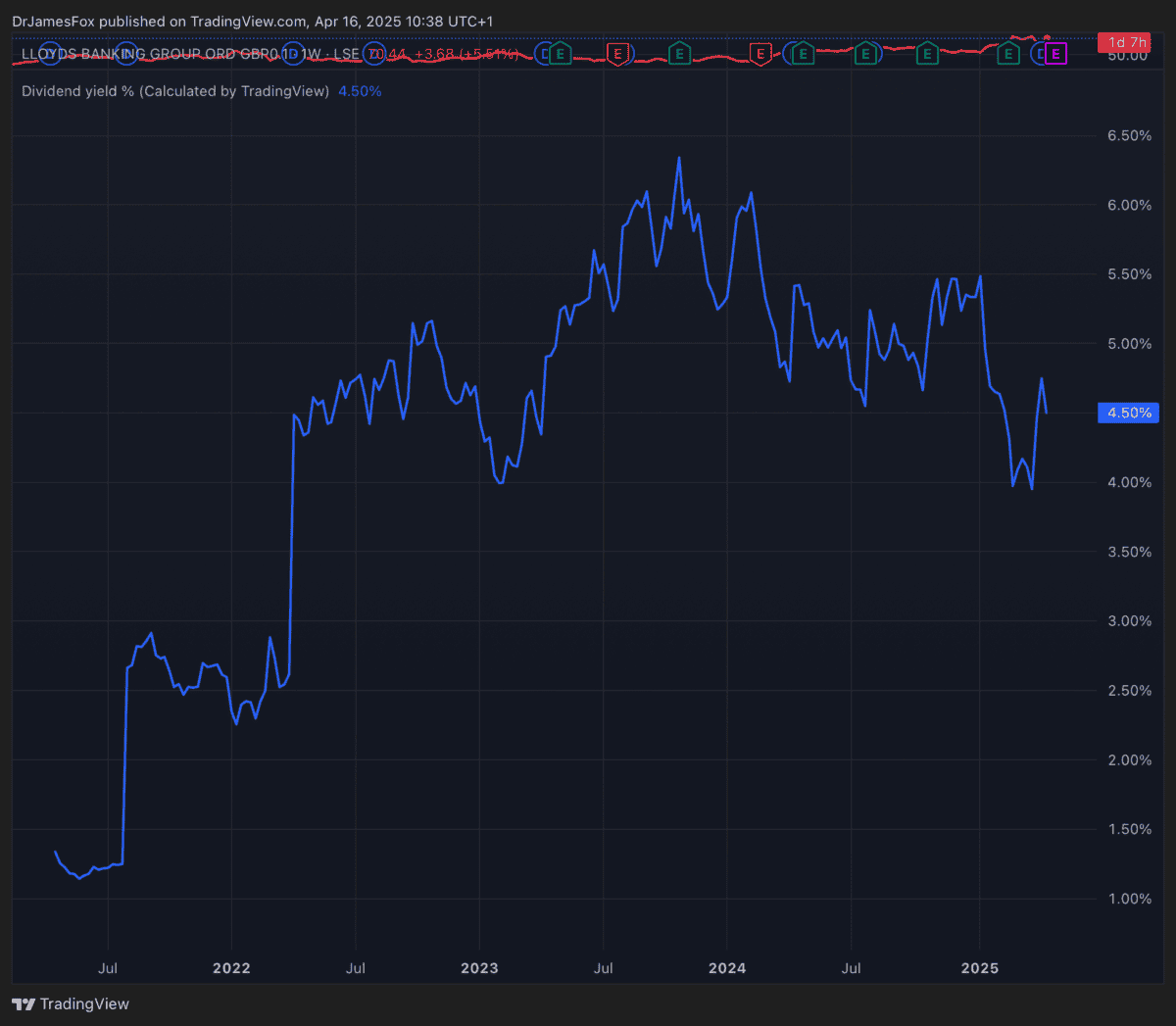
Source: TradingView — Trailing Dividend Yield

What’s more, the payout ratio remain sustainable.
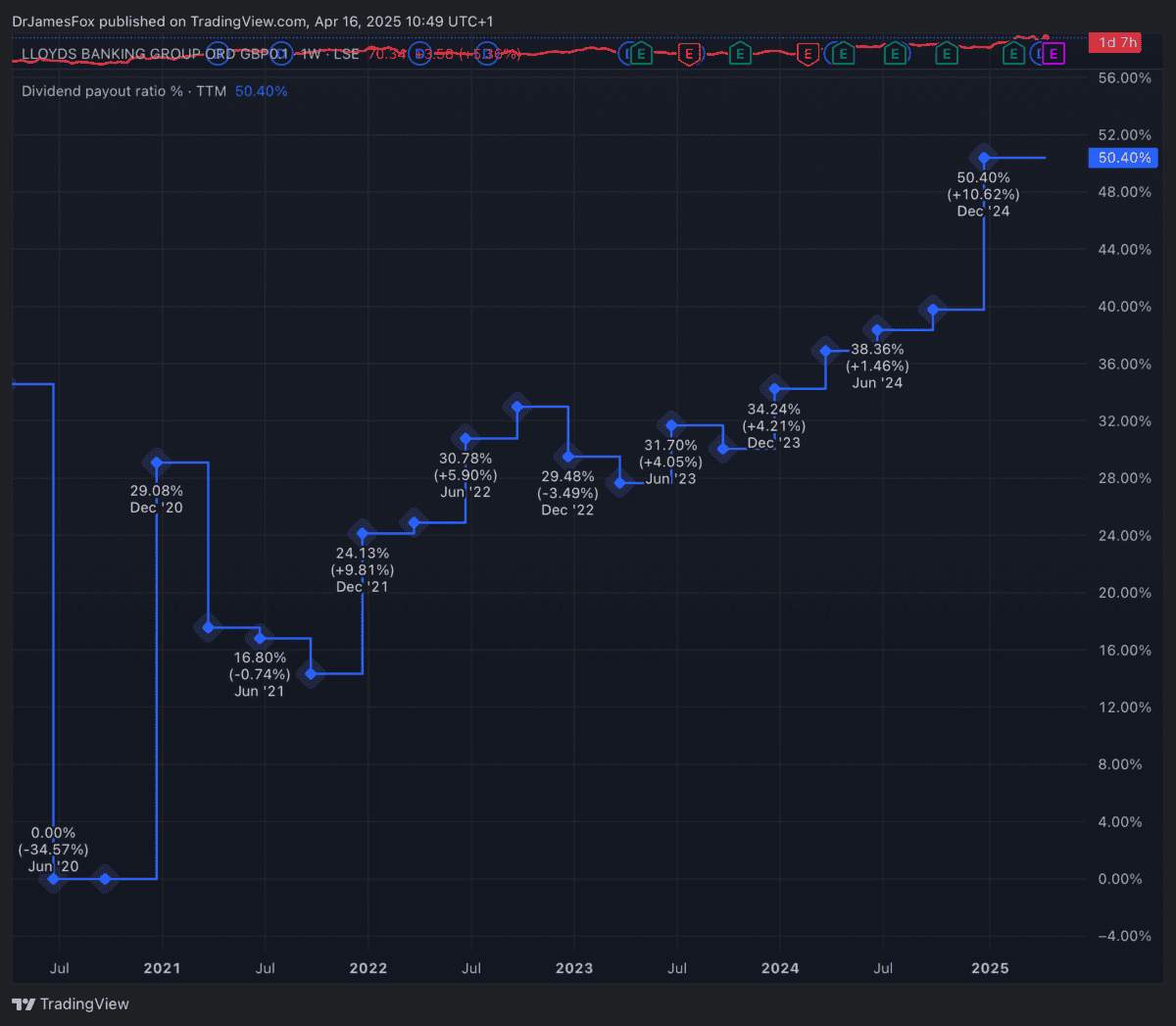
Source: TradingView

Risks persist, of course. The UK economy could face a slowdown because of US tariffs, and this really isn’t good for banks, which typically reflect the health of the economy. However, it’s still an interesting proposition. Personally, I’m just holding on to my Lloyds shares, rather than buying more, due to concentration risk.


James Fox has positions in Lloyds Banking Group Plc. The Motley Fool UK has recommended Lloyds Banking Group Plc. Views expressed on the companies mentioned in this article are those of the writer and therefore may differ from the official recommendations we make in our subscription services such as Share Advisor, Hidden Winners and Pro. Here at The Motley Fool we believe that considering a diverse range of insights makes us better investors.

More on Investing Articles

many happy international football fans watching tv
Investing Articles

Should I buy Diageo shares before the World Cup kicks off?

The World Cup is just a few days away! And its impact might be massive on Diageo shares – the…

Read more »

A rear view of a female in a bright yellow coat walking along the historic street known as The Shambles in York, UK which is a popular tourist destination in this Yorkshire city.
Investing Articles

2 high-yield ETFs to consider for a £1,615 ISA income!

Searching for ways to supercharge your passive income with ETFs? Consider these 7%+ dividend yielders in a Stocks and Shares…

Read more »

UK supporters with flag
Investing Articles

How have Lloyds shares become a dividend investor’s dream? 5 reasons why!

Looking for FTSE 100 stocks to buy for passive income? You may want to consider buying Lloyds' shares. But beware,…

Read more »

Close-up of British bank notes
Investing Articles

How are these FTSE 100 and FTSE 250 dividend stocks so cheap?!

Discover which FTSE 100 and FTSE 250 dividend stocks Royston Wild thinks are trading under value -- including a top-quality…

Read more »

Front view photo of a woman using digital tablet in London
Value Shares

How has Sage become one of the FTSE 100’s best bargain shares?

Sales and profits keep growing at double-digit rates. So why are Sage's share struggling? Royston Wild discusses this FTSE share.

Read more »

Young female couple boarding their plane at the airport to go on holiday.
Investing Articles

Can the Rolls-Royce share price reach £15.97 by the end of August?

The Rolls-Royce share price has had a solid run in the last year. Muhammad Cheema takes a look at whether…

Read more »

Santa Clara offices of NVIDIA
Investing Articles

Up 1,200% in 5 years, here’s why Nvidia could still be a brilliant value stock

An exciting new announcement that could reshape the PC industry has just pushed Nvidia stock... well, just about nowhere really.

Read more »

House models and one with REIT - standing for real estate investment trust - written on it.
Investing Articles

How investing £4.50 a day could set you on the way to a £1,505 monthly second income

How can UK stocks with high dividend yields help investors earn a meaningful second income from the price of a…

Read more »