
We have some exciting news to share! The Motley Fool UK has now become The Twelfth Magpie -- an independent, UK-owned company, led by our long-serving UK management team — Mark Rogers, Chris Nials and Heather Adlington. In practical terms, it’s the same team you know, now fully focused on serving our UK readers and members.

Just as importantly, our approach remains unchanged: long-term, jargon-free, and on your side. This site is our new home, and there will be extra tweaks made across the coming few days as we settle in. So if anything looks a little off, please bear with us!

The content of this article was relevant at the time of publishing. Circumstances change continuously and caution should therefore be exercised when relying upon any content contained within this article.

Nearing 500p, is the Aviva share price still cheap? Here’s what the charts say!

Aviva is up 20% in the past year, outperforming the FTSE — but can the share price still grow further? I’m checking the charts to find out.

| More on:
Aviva logo on glass meeting room door

Image source: Aviva plc

You’re reading a free article with opinions that may differ from The Twelfth Magpie’s Premium Investing Services. Become a member today to get instant access to our top analyst recommendations, in-depth research, investing resources, and more. Learn more, and get a free 'Best Buy Now' stock!.

After a strong first quarter, the Aviva (LSE: AV.) share price has tapered off, down 4.7% since this year’s high. But over the past year, it’s outperformed the Footsie and is now near a seven-year high. 

The shares are trading at £4.73, slightly down from the May high of £4.97.

Should you buy Aviva Plc shares today?

Before you decide, please take a moment to review this report first. Despite ongoing uncertainties from US tariffs to global conflicts, Mark Rogers and his team believe many UK shares still trade at substantial discounts, offering savvy investors plenty of potential opportunities to learn about.

That’s why this could be an ideal time to secure this valuable research – Mark’s analysts have scoured the markets to reveal 5 of his favourite long-term ‘Buys’. Please, don’t make any big decisions before seeing them.

So where is the stock headed from here?

To find out, I’m charting some key growth metrics that may reveal hidden clues.

Price-to-earnings

I always check the price-to-earnings (P/E) ratio first to get a rough idea of the value. If the price is a lot higher than earnings the stock could be overvalued, limiting further growth. But a low P/E ratio suggests the price hasn’t caught up with earnings yet and further growth is to be expected.

Currently, the average P/E ratio on the UK market is 18.4, near the highest it’s been in several years. Aviva’s P/E ratio of 12.7 is comparatively low, suggesting the stock has decent growth potential.
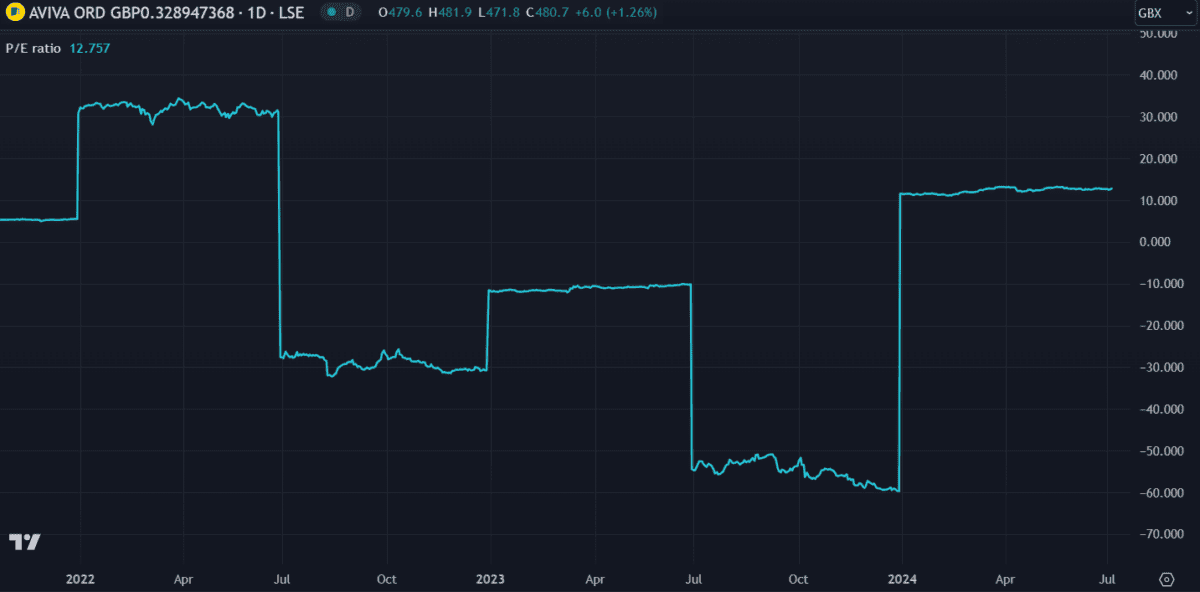
aviva share price PE ratio
Created on TradingView.com

Dividend yield

One of Aviva’s key value propositions is that it’s a known dividend payer. The ability to give back a portion of profits to shareholders is a strong indication that a company is performing well. For the past two decades, it’s paid fluctuating annual dividends of between 15p and 30p per share. Overall, there hasn’t been much growth but payments have been consistent.

The dividend yield indicates what percentage of the current share price is paid annually. Currently at 7.68%, we can see from the chart that it’s been growing consistently since 2021. It’s now the seventh-highest dividend yield on the FTSE 100 — albeit slightly below competitor Legal & General, in fifth place.
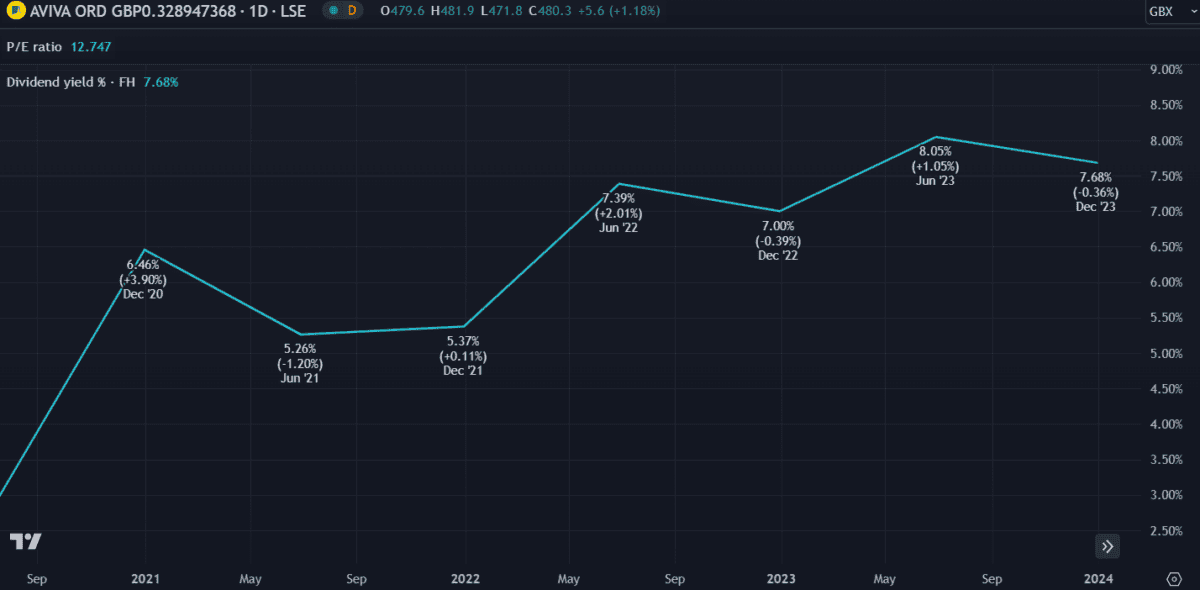
aviva share price dividend yield
Created on TradingView.com

Debt

Debt can be very useful to a company if used correctly. In fact, it’s considered a critical part of any successful company’s operations. But when used as a lifeline, it can become a problem. The below chart shows three important metrics: debt, equity, and debt-to-equity (D/E) ratio. We can see that debt has been declining, which is good. However, equity has declined at a faster rate, leading to a rise in the D/E ratio.
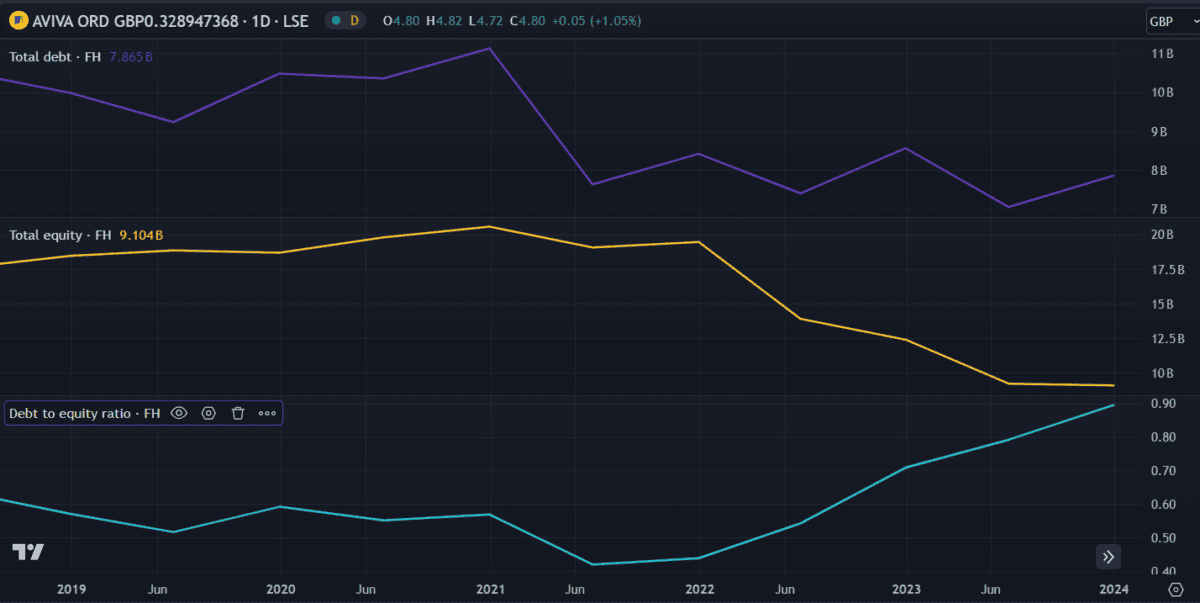
aviva debt
Created on TradingView.com

The D/E ratio should ideally remain below one. With Aviva’s now at 0.9, it’s getting dangerously close to having more debt than equity. This is a concerning situation. If a company doesn’t have sufficient equity or cash flow to cover its debt, it may default — or in a worst-case scenario, go bankrupt.

Fortunately, Aviva has a lot of cash and assets, so that’s not a risk for now.

My verdict

Considering the above metrics, the Aviva share price still looks cheap to me. This is reflected in the P/E ratio and supported by future earnings estimates, which calculate it trading at 42% below fair value. But that doesn’t mean it’ll grow. 

The UK’s insurance market is cut-throat and Aviva faces many rivals. If an economic recovery is delayed, consumers may seek out cheaper alternatives, threatening profits. With equity declining and debt rising, it can’t afford to lose customers at this crucial point. 

On paper, things look good and I think the share price could improve from here. But I wouldn’t expect huge growth. Fortunately, the high dividend yield gives the stock great value either way.

Mark Hartley has positions in Aviva Plc and Legal & General Group Plc. The Motley Fool UK has no position in any of the shares mentioned. Views expressed on the companies mentioned in this article are those of the writer and therefore may differ from the official recommendations we make in our subscription services such as Share Advisor, Hidden Winners and Pro. Here at The Motley Fool we believe that considering a diverse range of insights makes us better investors.

More on Investing Articles

Close-up of British bank notes
Investing Articles

How are these FTSE 100 and FTSE 250 dividend stocks so cheap?!

Discover which FTSE 100 and FTSE 250 dividend stocks Royston Wild thinks are trading under value -- including a top-quality…

Read more »

Front view photo of a woman using digital tablet in London
Value Shares

How has Sage become one of the FTSE 100’s best bargain shares?

Sales and profits keep growing at double-digit rates. So why are Sage's share struggling? Royston Wild discusses this FTSE share.

Read more »

Young female couple boarding their plane at the airport to go on holiday.
Investing Articles

Can the Rolls-Royce share price reach £15.97 by the end of August?

The Rolls-Royce share price has had a solid run in the last year. Muhammad Cheema takes a look at whether…

Read more »

Santa Clara offices of NVIDIA
Investing Articles

Up 1,200% in 5 years, here’s why Nvidia could still be a brilliant value stock

An exciting new announcement that could reshape the PC industry has just pushed Nvidia stock... well, just about nowhere really.

Read more »

House models and one with REIT - standing for real estate investment trust - written on it.
Investing Articles

How investing £4.50 a day could set you on the way to a £1,505 monthly second income

How can UK stocks with high dividend yields help investors earn a meaningful second income from the price of a…

Read more »

Investing Articles

Up 103% with a P/E of 261 — is this FTSE 100 stock still worth buying?

One FTSE 100 stock is quietly moving higher while most investors are still looking elsewhere — is the market missing…

Read more »

Concept of two young professional men looking at a screen in a technological data centre
Investing Articles

The smart money thinks AI stocks look risky — but is there still a chance to buy?

According to fund managers, the AI trade is getting crowded. But they still seem to think it’s the place to…

Read more »

Man putting his card into an ATM machine while his son sits in a stroller beside him.
Investing Articles

Barclays shares are 11% below their 52-week high. Could they be a bit of a bargain to consider?

Overpriced or one of the FTSE 100’s hidden gems? James Beard takes a closer look at how the market is…

Read more »