We have some exciting news to share! The Motley Fool UK has now become The Twelfth Magpie -- an independent, UK-owned company, led by our long-serving UK management team — Mark Rogers, Chris Nials and Heather Adlington. In practical terms, it’s the same team you know, now fully focused on serving our UK readers and members.

Just as importantly, our approach remains unchanged: long-term, jargon-free, and on your side. This site is our new home, and there will be extra tweaks made across the coming few days as we settle in. So if anything looks a little off, please bear with us!

The content of this article was relevant at the time of publishing. Circumstances change continuously and caution should therefore be exercised when relying upon any content contained within this article.

As the BT share price slides, here’s how many shares I’d need for £2,000 a year in passive income!

On paper, this telecoms giant looks like one of the strongest dividend stocks on the index. So, does the falling BT share price represent an opportunity?

| More on:
Young black colleagues high-fiving each other at work

Image source: Getty Images

You’re reading a free article with opinions that may differ from The Twelfth Magpie’s Premium Investing Services. Become a member today to get instant access to our top analyst recommendations, in-depth research, investing resources, and more. Learn more, and get a free 'Best Buy Now' stock!.

Some investors may see the falling BT (LSE:BT.A) share price as an attractive opportunity to enhance passive income generation. The telecoms firm currently offers a 6.66% dividend yield, making it one of the strongest on the FTSE 100.

The maths is quite easy here. If I wanted to earn £2,000 a year in dividend payments from BT shares, I’ve got to own £30,000 of the stock. At the moment, that’s 25,862 shares.

Should you buy Bt Group Plc shares today?

Before you decide, please take a moment to review this report first. Despite ongoing uncertainties from US tariffs to global conflicts, Mark Rogers and his team believe many UK shares still trade at substantial discounts, offering savvy investors plenty of potential opportunities to learn about.

That’s why this could be an ideal time to secure this valuable research – Mark’s analysts have scoured the markets to reveal 5 of his favourite long-term ‘Buys’. Please, don’t make any big decisions before seeing them.

So, there’s several things worth considering here. Firstly, should I be buying the shares, and would I want £30,000 of them if I could afford it?


Value can be misleading

Valuation metrics can be misleading. And that appears to be the case here. BT shares trade with a forward price-to-earnings ratio of 7.3.

That’s a 59.2% discount versus the communications sector average and approximately a 40% discount to the FTSE 100 average.

BT looks pretty cheap on other near-term metrics too. It trades with a forward enterprise value-to-EBTIDA ratio of 3.99. In turn, this represents a 54.2% discount versus the sector average.

Likewise, it trades with a forward price-to-sales ratio of 0.54, representing a 55.9% discount to the sector.

All these metrics look great. It’s an ‘A+ grade’ on near-term metrics. However, sometimes near-term metrics can be misleading.

So, why is that? Well, it’s because of growth. BT Group does not offer explosive growth. In fact, according to the consensus forecast — below — it offers almost no growth at all throughout the medium term.

202420252026
EPS (p)15.515.115.9

Dividends might not be sustainable

There are several ways to look at the dividend. It looks sustainable today, but it might not be in the future.

Firstly, in 2023, the dividend was covered 2.52 times by earnings. In other words, that’s a payout ratio of 0.4, which is very strong. A dividend coverage ratio above two is normally considered healthy.

However, there are concerns about the debt, cash flow and BT’s capital expenditure (CAPEX) requirements over the coming years.

BT has a net debt in excess of £19.7bn — up from £18.9bn in March — and analysts are forecasting a CAPEX burden around £15bn as the firm continues its rollout of FTTP (fibre to the premises).

BT is targeting taking its fibre product to 15-20m households in the UK, and as a general rule of thumb, it costs around £85m to rollout FTTP to 100,000 households.

So, this would mean £15bn in CAPEX over the years to 2029. In addition to its sizeable debt burden (debt maturity profile below) these CAPEX requirements could make the dividend less sustainable.
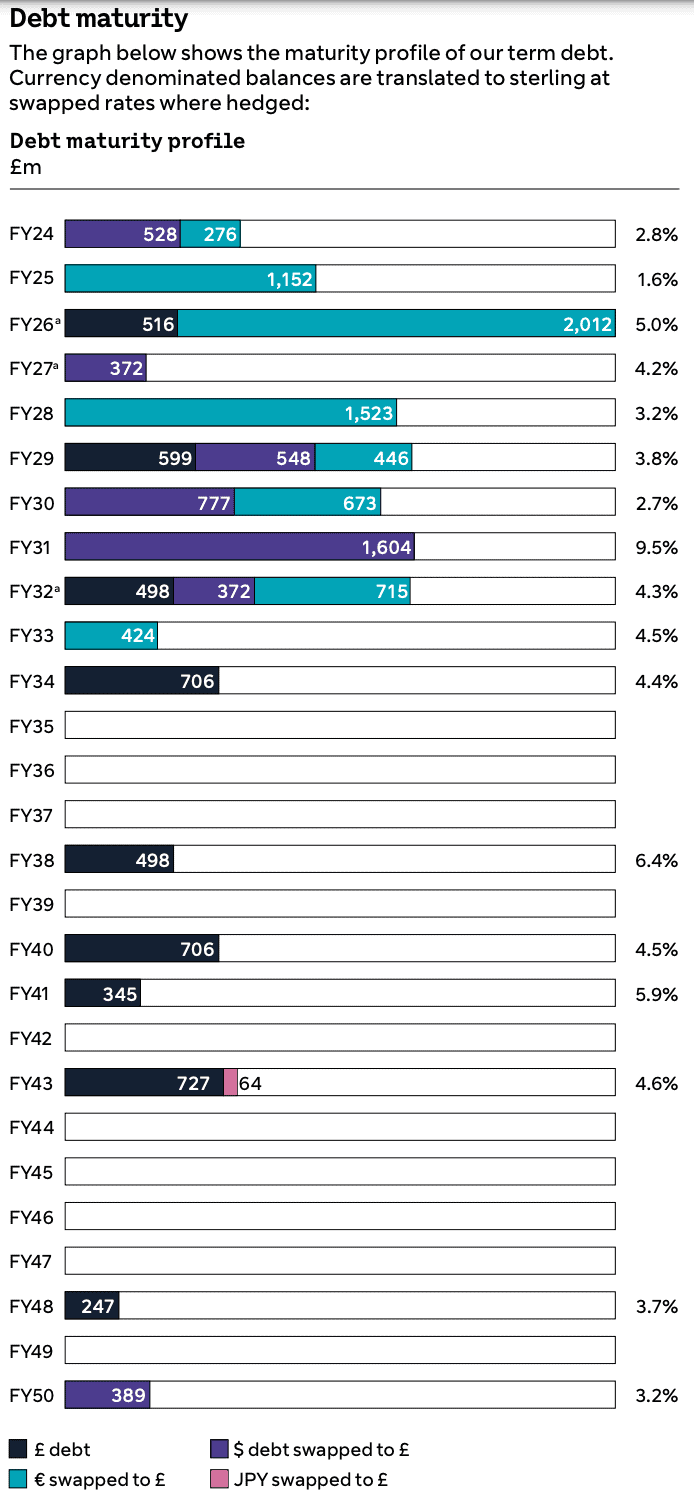
Source: BT 2023 Report

The bottom line

Earnings growth is slow, debt is sizeable, and CAPEX requirements are gigantic. In turn, if I were investing for dividends, I’d look elsewhere. The dividend may looks sustainable now, but CAPEX and debt repayments could eat into earnings as we move through the decade. Even if I were investing £30,000, I wouldn’t be picking BT.


James Fox has no position in any of the shares mentioned. The Motley Fool UK has no position in any of the shares mentioned. Views expressed on the companies mentioned in this article are those of the writer and therefore may differ from the official recommendations we make in our subscription services such as Share Advisor, Hidden Winners and Pro. Here at The Motley Fool we believe that considering a diverse range of insights makes us better investors.

More on Investing Articles

Close-up as a woman counts out modern British banknotes.
Investing Articles

How to buy growth stocks at below-market prices

Don’t want to pay market prices for growth stocks? Here's a sneaky strategy investors can use to get deals at…

Read more »

CEO Mark Zuckerberg at F8 2019 event
Investing Articles

Are Meta shares at the start of a comeback?

Shares in Meta Platforms have been held back by the firm’s high-risk approach to AI. But is this the moment…

Read more »

UK financial background: share prices and stock graph overlaid on an image of the Union Jack
Investing Articles

With dividend yields averaging above 7%, are these 2 UK shares worth considering?

Muhammad Cheema looks at two UK shares: ITV and Legal & General. With yields of 6.1% and 8.1%, should investors…

Read more »

Close-up as a woman counts out modern British banknotes.
Investing Articles

How much do you need to invest in dividend stocks to be able to retire?

Some 77% of people in the UK won't have enough income to manage a moderate retirement. Here’s how dividend stocks…

Read more »

Abstract bull climbing indicators on stock chart
Investing Articles

FTSE 250 stock CMC’s shares have rocketed 51%! What’s going on?

CMC Markets' shares have surged by double-digits today after a strong full-year trading update. Is the FTSE 250 company now…

Read more »

A row of satellite radars at night
Investing Articles

Will I buy SpaceX at £100 a share in my SIPP?

Ben McPoland is considering adding SpaceX stock to his SIPP on 12 June. Might this be a no-brainer buy-and-hold opportunity?

Read more »

Young brown woman delighted with what she sees on her screen
Investing Articles

Aberdeen shares are back in the FTSE 100 — is this turnaround stock just getting started?

Following its return to the FTSE 100, Andrew Mackie examines whether Aberdeen's shares could be on the cusp of a…

Read more »

Shot of an young mixed-race woman using her cellphone while out cycling through the city
Investing Articles

Down 65% with a 5.65% yield! Is this dividend share a once-in-a-decade buy? 

Harvey Jones says this dividend share is still posting decent profits at a challenging time. Its low valuation and high…

Read more »