
We have some exciting news to share! The Motley Fool UK has now become The Twelfth Magpie -- an independent, UK-owned company, led by our long-serving UK management team — Mark Rogers, Chris Nials and Heather Adlington. In practical terms, it’s the same team you know, now fully focused on serving our UK readers and members.

Just as importantly, our approach remains unchanged: long-term, jargon-free, and on your side. This site is our new home, and there will be extra tweaks made across the coming few days as we settle in. So if anything looks a little off, please bear with us!

The content of this article was relevant at the time of publishing. Circumstances change continuously and caution should therefore be exercised when relying upon any content contained within this article.

2 key investment themes to watch in 2024

Andrew Mackie discusses two of his highest-conviction investment themes for 2024 and explains how he is positioning his portfolio accordingly.

2024 year number handwritten on a sandy beach at sunrise

Image source: Getty Images

You’re reading a free article with opinions that may differ from The Twelfth Magpie’s Premium Investing Services. Become a member today to get instant access to our top analyst recommendations, in-depth research, investing resources, and more. Learn more, and get a free 'Best Buy Now' stock!.

As a private investor, I find a lot of my time is taken up reading around the latest trends and economic data in an attempt to glean investment ideas. In its latest press release, AJ Bell’s investment director, Russ Mould points to five themes to watch in 2024. Of the five, these are my top two.

Public debt

The eye-watering sums of public money borrowed over the past few years, both in the UK and US, showed no sign of abating in 2023.

Should you buy Rolls Royce shares today?

Before you decide, please take a moment to review this report first. Despite ongoing uncertainties from US tariffs to global conflicts, Mark Rogers and his team believe many UK shares still trade at substantial discounts, offering savvy investors plenty of potential opportunities to learn about.

That’s why this could be an ideal time to secure this valuable research – Mark’s analysts have scoured the markets to reveal 5 of his favourite long-term ‘Buys’. Please, don’t make any big decisions before seeing them.

In the US, the Congressional Budget Office recently published its projection for the fiscal balance relative to gross domestic product (GDP), for the next decade. As shown in the chart below, the average works out at about 6% of GDP.
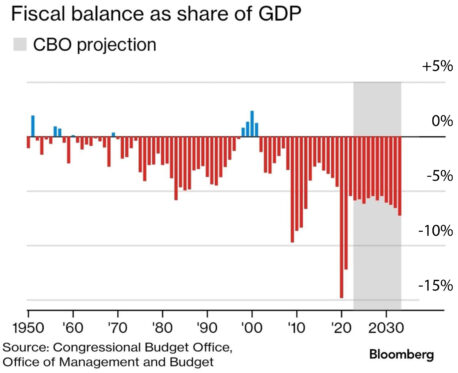
Source: CBO and Bloomberg

If this prediction is accurate, it means that over the next 10 years the gap between the amount the government spends and what it takes in from taxes will widen. This is known as a fiscal imbalance.

Today, total US public debt stands at over $33trn. Assuming a 6% fiscal budget, that debt will double in just 12 years. As an investor, this matters hugely.

First, it means the government will need to issue a huge number of bonds in order to finance its spending. A surge in supply means that yields on those bonds will likely need to rise. That makes bonds highly unattractive as a long-term investment.

Secondly, surging public debt means that tangible assets are likely to be sought after by investors. Particularly gold and silver.

It’s no coincidence to me that only last week gold reached record highs. When one considers the lack of investor capital allocated to gold mining stocks today, this presents me with an incredible opportunity to buy at depressed prices.

Wage-price spiral

One of the hallmarks that emerged from the inflationary decade of the 1970s, was the concept of the wage-price spiral.

Inflation might not be running quite as hot in 2023, but that didn’t stop a wave of strikes emerging both across the public and private sector. A related feature was the re-emergence of trade union power.

The pay deals that some Unions have being able to negotiate with employers, would have been unthinkable just a few years ago. UPS and Ford’s huge pay deals certainly helped them hit the headlines, but they just represent the tip of the iceberg.

Rising inflation

One of the consequences of rising wages is structural inflation. As households continue to see cost of living pressures, they begin to demand even higher wages. Ultimately it leads to stagflation. This is where inflation remains elevated while growth is low.

Structural rises in wages and salaries is one of the reasons why I remain so bearish on big tech, including the ‘Magnificent Seven’ stocks. As profits at many of these firms have reached record highs, I find it hard to believe that employees won’t end up demanding a bigger slice of the pie.

The re-emergence of the inflation narrative over the next few years, is one of my higher-conviction investment themes.

This conviction is rooted in an impending shortage in many of the metals needed to make net zero a reality. That’s why I’m invested heavily in various commodities stocks.


Andrew Mackie has no position in any of the shares mentioned. The Motley Fool UK has no position in any of the shares mentioned. Views expressed on the companies mentioned in this article are those of the writer and therefore may differ from the official recommendations we make in our subscription services such as Share Advisor, Hidden Winners and Pro. Here at The Motley Fool we believe that considering a diverse range of insights makes us better investors.

More on Investing Articles

House models and one with REIT - standing for real estate investment trust - written on it.
Investing Articles

How investing £4.50 a day could set you on the way to a £1,505 monthly second income

How can UK stocks with high dividend yields help investors earn a meaningful second income from the price of a…

Read more »

Investing Articles

Up 103% with a P/E of 261 — is this FTSE 100 stock still worth buying?

One FTSE 100 stock is quietly moving higher while most investors are still looking elsewhere — is the market missing…

Read more »

Concept of two young professional men looking at a screen in a technological data centre
Investing Articles

The smart money thinks AI stocks look risky — but is there still a chance to buy?

According to fund managers, the AI trade is getting crowded. But they still seem to think it’s the place to…

Read more »

Man putting his card into an ATM machine while his son sits in a stroller beside him.
Investing Articles

Barclays shares are 11% below their 52-week high. Could they be a bit of a bargain to consider?

Overpriced or one of the FTSE 100’s hidden gems? James Beard takes a closer look at how the market is…

Read more »

Stack of one pound coins falling over
Investing Articles

Down 65% but yielding 6.7% – is this beaten-down UK stock now a generational bargain?

Harvey Jones says this UK stock is one of the worst FTSE 100 performers but there are sound reasons to…

Read more »

Portrait of elderly man wearing white denim shirt and glasses looking up with hand on chin. Thoughtful senior entrepreneur, studio shot against grey background.
Investing Articles

Is this FTSE stock really 46% undervalued?

Analysts reckon this FTSE stock should be worth nearly 50% more. James Beard considers why there’s so much positivity surrounding…

Read more »

Front view of a young couple walking down terraced Street in Whitley Bay in the north-east of England they are heading into the town centre and deciding which shops to go to they are also holding hands and carrying bags over their shoulders.
Investing Articles

How much is needed in an ISA for passive income that covers the UK’s monthly average rent of £1,381?

The UK’s monthly average rent for May 2026 is £1,381. Muhammad Cheema looks at how much is needed to aim…

Read more »

A rear view of a female in a bright yellow coat walking along the historic street known as The Shambles in York, UK which is a popular tourist destination in this Yorkshire city.
Investing Articles

How have BAE Systems shares become a dividend powerhouse? 5 reasons why!

Dividends on BAE Systems shares have risen every year without fail since the early 2000s. So what's the FTSE 100…

Read more »