We have some exciting news to share! The Motley Fool UK has now become The Twelfth Magpie -- an independent, UK-owned company, led by our long-serving UK management team — Mark Rogers, Chris Nials and Heather Adlington. In practical terms, it’s the same team you know, now fully focused on serving our UK readers and members.

Just as importantly, our approach remains unchanged: long-term, jargon-free, and on your side. This site is our new home, and there will be extra tweaks made across the coming few days as we settle in. So if anything looks a little off, please bear with us!

The content of this article was relevant at the time of publishing. Circumstances change continuously and caution should therefore be exercised when relying upon any content contained within this article.

If I’d invested £1,000 in BP shares 10 years ago, here’s what I’d have now

BP shares have fallen after a Q3 earnings miss, despite a sizeable $1.5bn buyback. Dr James Fox takes a closer look at this energy giant.

| More on:
Workers at Whiting refinery, US

Image source: BP plc

You’re reading a free article with opinions that may differ from The Twelfth Magpie’s Premium Investing Services. Become a member today to get instant access to our top analyst recommendations, in-depth research, investing resources, and more. Learn more, and get a free 'Best Buy Now' stock!.

BP (LSE:BP) shares dipped on Tuesday (31 October) after the company’s earnings came in lighter than expected. Consensus among analysts had been for $4.01bn (£3.3bn) in replacement cost profit. However, BP actually reported replacement cost profit of $3.3bn (£2.7bn).

As a side note, this shows just how difficult it can be for even the most experienced analysts to correctly forecast earnings, particularly BP. I recently produced a share tip for the energy giant, and I’m delighted to say I was under consensus. However, I didn’t see earnings being this low.

Should you buy Bp P.l.c. shares today?

Before you decide, please take a moment to review this report first. Despite ongoing uncertainties from US tariffs to global conflicts, Mark Rogers and his team believe many UK shares still trade at substantial discounts, offering savvy investors plenty of potential opportunities to learn about.

That’s why this could be an ideal time to secure this valuable research – Mark’s analysts have scoured the markets to reveal 5 of his favourite long-term ‘Buys’. Please, don’t make any big decisions before seeing them.


What the earnings say

Q3 won’t be remembered as one of BP’s strongest quarters, given the earnings miss and the earlier departure of CEO Bernard Looney.

The results showed improvement from the $2.6bn in the previous quarter, but fell significantly short of the $8.2bn achieved in Q3 of 2022.

Despite these challenges, the quarterly growth was driven by higher realised refining margins, reduced levels of refining maintenance, a robust performance in oil trading, and increased oil and gas production.

However, these positive factors were somewhat offset by weaker results in gas marketing and trading.

The company reported an increase in operating cash flow to $8.7bn from $6.3bn in the second quarter, and it reduced net debt to $22.3bn from $23.7bn over period.

10-year trend

So what if I’d invested in BP shares a decade ago? How well would my investment be doing today?

Well, the answer isn’t that good. The stock is up 4.5% over 10 years. That works out at less that 0.5% a year, plus dividends, which have been relatively strong.

Including dividends, my annualised total returns would be somewhere in the region of 4-5%. It’s not the worst, but it could be much better.

The next 10 years

Before I look at the macroeconomic forecasts, let’s take a closer look at BP versus the rest of the ‘Big Six’ vertically integrated oil companies.

Firstly, it’s worth noting that BP reportedly has a lower unit cost than its peers. Between 2010-2019, BP’s 10-year average upstream unit production cost ($9.46bn a barrel of oil equivalent) was roughly 18% less than that of Shell ($11.64).

When I worked in the industry and was writing my PhD, I was told that BP was always at the forefront of technology, in theory driving efficiencies. Perhaps as a result, BP’s return on total capital (TTM) is 16.7%, higher than all its peers.

However, when we look at the asset turnover ratio and net income margin, we can see BP is less competitive. This probably reflect’s BP’s higher debt burden, which partially stems from the Deepwater Horizon disaster. This is highlighted below.
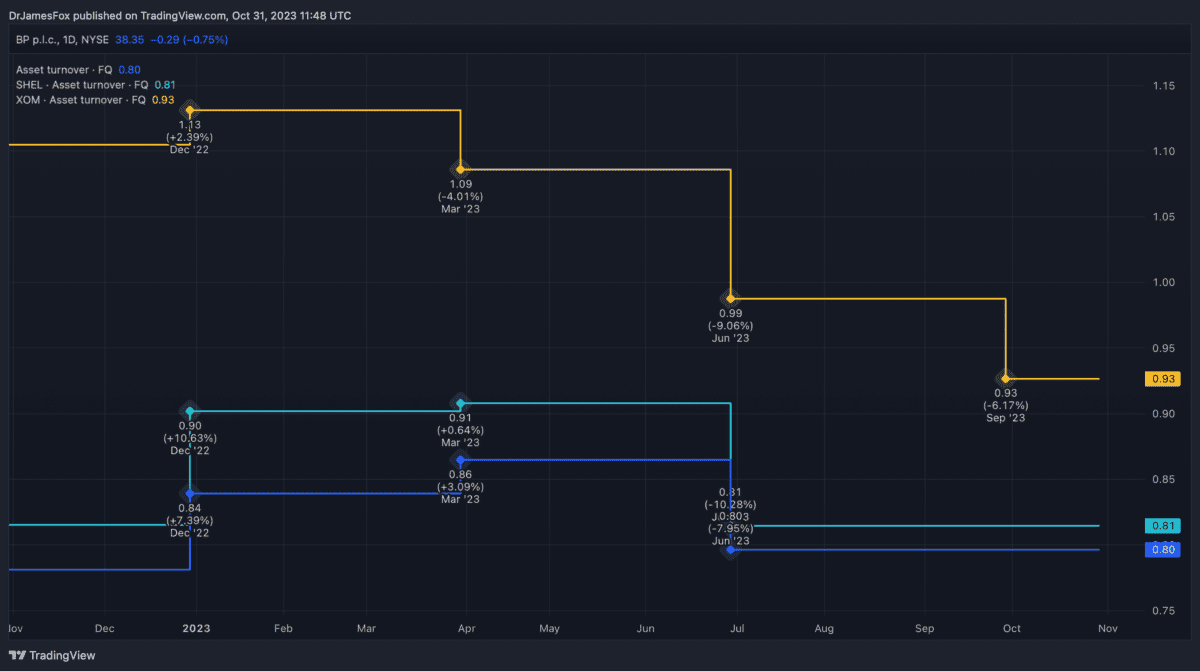
Created at TradingView: Asset Turnover

Looking at the macroeconomic picture, it’s hard to ignore the impact of growing populations, a growing middle class, and a dearth of untapped natural resources.

These factors all point to higher oil and gas prices over the next decade versus the previous decade. This is the consensus view, and should result in improved revenues over the next decade. In turn, this is also central to the investment hypothesis.

Given the geopolitical tensions and resultant energy volatility, I’m not buying BP now. However, I’m bullish on long-term prospects and will look for an improved entry points.

James Fox has no position in any of the shares mentioned. The Motley Fool UK has no position in any of the shares mentioned. Views expressed on the companies mentioned in this article are those of the writer and therefore may differ from the official recommendations we make in our subscription services such as Share Advisor, Hidden Winners and Pro. Here at The Motley Fool we believe that considering a diverse range of insights makes us better investors.

More on Investing Articles

Close-up of British bank notes
Investing Articles

As British American Tobacco shares dip, is this a hot buying opportunity?

Are British American Tobacco shares on their way to completing another decade of dividend growth? Let's check out this latest…

Read more »

DIVIDEND YIELD text written on a notebook with chart
Investing Articles

I’m targeting a yearly income of £6,898 from £20,000 in this FTSE heavyweight!

This FTSE dividend play looks far too cheap for the cash it throws off — and the mix of rising…

Read more »

Passive income text with pin graph chart on business table
Investing Articles

How much would I need to invest in this FTSE 100 dividend gem to aim for £14,754 a year in passive income?

Passive income is the goal for many investors, and this FTSE dividend star highlights the qualities that can turn long‑term…

Read more »

View over Old Man Of Storr, Isle Of Skye, Scotland
Investing Articles

How much do you need in a SIPP to earn a £667 monthly passive income?

Harvey Jones shows how investors could use the generous tax breaks available on a Self-Invested Personal Pension, or SIPP, to…

Read more »

Happy male couple looking at a laptop screen together
Investing Articles

Up 50% with a stunning 6.4% yield! How do Aviva shares do it?

Harvey Jones is hugely impressed by the recent performance of Aviva shares, and examines why the FTSE 100 insurer has…

Read more »

Satellite on planet background
Investing Articles

Down 19% to under £20! Is now exactly the right time for me to capitalise on BAE Systems’ bargain-basement share price?

BAE Systems’ share price has dropped sharply, but a far bigger long term demand cycle is only just beginning. Here’s…

Read more »

Person holding magnifying glass over important document, reading the small print
Investing Articles

Closing in on £33 and around an all‑time high, is this FTSE 250 favourite seriously mispriced?

With the shares pushing into record territory, I’ve revisited the underlying business, its growth outlook and the valuation picture investors…

Read more »

Close-up of British bank notes
Investing Articles

£20,000 invested in Barclays shares a year ago is now worth…

Barclays shares have quietly delivered a 41% return in just 12 months — and the long term numbers suggest the…

Read more »