
We have some exciting news to share! The Motley Fool UK has now become The Twelfth Magpie -- an independent, UK-owned company, led by our long-serving UK management team — Mark Rogers, Chris Nials and Heather Adlington. In practical terms, it’s the same team you know, now fully focused on serving our UK readers and members.

Just as importantly, our approach remains unchanged: long-term, jargon-free, and on your side. This site is our new home, and there will be extra tweaks made across the coming few days as we settle in. So if anything looks a little off, please bear with us!

The content of this article was relevant at the time of publishing. Circumstances change continuously and caution should therefore be exercised when relying upon any content contained within this article.

Should I buy Lloyds shares after SVB’s collapse?

FTSE bank shares are falling after the recent collapse of SVB, and Lloyds has been no exception. Could this be a buying opportunity?

| More on:
Young Black woman looking concerned while in front of her laptop

Image source: Getty Images

You’re reading a free article with opinions that may differ from The Twelfth Magpie’s Premium Investing Services. Become a member today to get instant access to our top analyst recommendations, in-depth research, investing resources, and more. Learn more, and get a free 'Best Buy Now' stock!.

The collapse of Silicon Valley Bank (SVB) has investors running for the hills, fearing a repeat of the 2008 financial crisis. That said, there’s reason to believe that this fear may be overdone, especially with Lloyds (LSE:LLOY) shares, which have dropped almost 10% in a week.

How did SVB collapse?

SVB’s fall started when it opted to invest the bulk of its customers’ deposits into risk-weighted assets, such as long-dated government bonds. These securities are very sensitive to interest rates. Thus, they saw a massive decline in value when the Federal Reserve aggressively raised rates last year.

Should you buy Lloyds Banking Group Plc shares today?

Before you decide, please take a moment to review this report first. Despite ongoing uncertainties from US tariffs to global conflicts, Mark Rogers and his team believe many UK shares still trade at substantial discounts, offering savvy investors plenty of potential opportunities to learn about.

That’s why this could be an ideal time to secure this valuable research – Mark’s analysts have scoured the markets to reveal 5 of his favourite long-term ‘Buys’. Please, don’t make any big decisions before seeing them.

The lender was then forced to sell those bonds at a huge loss when the majority of its clients in the tech and crypto industry came banging on its door for cash. To put it simply, SVB faced a liquidity crisis in the middle of a bank run.

To mitigate the catastrophe, the board attempted to raise capital via equity. However, this spooked investors and led to more withdrawals. It sent the stock crashing along with many of its peers, such as Silvergate Capital and First Republic Bank, which saw drops of up to 80%.

Can the same happen to Lloyds?

It’s no surprise to see the Lloyds share price drop too as investors fear a contagion event. And while a similar scenario could play out with Lloyds, it’s highly unlikely for several reasons.

Firstly, unlike its US counterpart, the Black Horse bank discloses its liquidity coverage ratio. As of its latest earnings report, this stands at 144%. What’s more, it has a solid CET1 ratio (which compares a bank’s capital against its assets) of 15.1% — much stronger than most other banks.

Additionally, investors may find comfort in Lloyds’ in low-risk deposit base. That’s because unlike SVB, the bulk of its clients are retail customers. This means that a bank run is unlikely to test the FTSE 100 stalwart’s liquidity as retail customers don’t tend to hold as much cash as commercial clients.
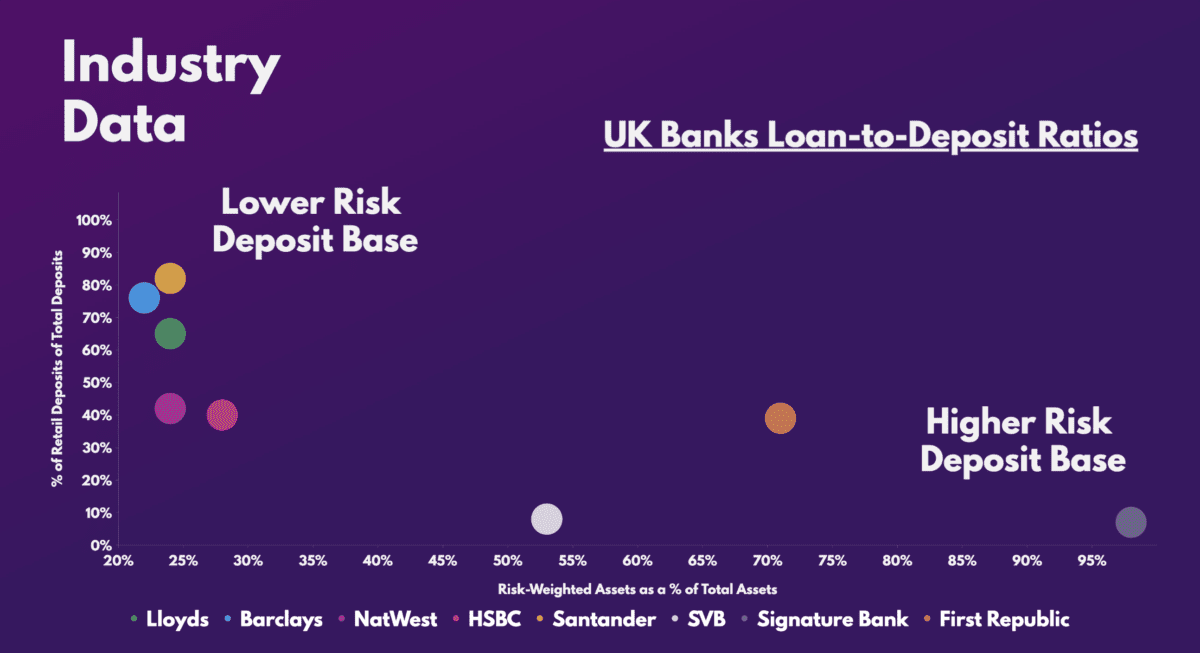
Lloyds Shares - UK Banks Loan-to-Deposit Ratios.
Data source: Lloyds, Barclays, NatWest, HSBC, Santander UK, SVB, Signature Bank, First Republic

More importantly, its percentage of risk-weighted assets isn’t nearly as high as its collapsing US counterparts. Pair this with the fact that Lloyds stores a healthy pile of its cash (£9.14bn) with the Bank of England, and it reinforces its margin of safety.

Should I buy Lloyds shares?

Investing in bank stocks carry a high amount of risks. Hence, it’s important to buy shares only in banks with strong fundamentals and a low exposure to risk, especially times like these. Lloyds is one such example.

Given its strong financial footing, and less risky asset base, it seems well equipped to weather the current downturn and a potential contagion event. This sentiment is echoed by the likes of JP Morgan and Liberium, who say that the current decline presents an opportunity for investors.

And when considering its valuation multiples, it certainly seems like it. After all, Citi reiterated its ‘top pick’ rating for the stock, with Goldman Sachs and Barclays also rating the shares a ‘buy’ with an average price target of 75p. This presents a 60% upside from current levels.

MetricsLloydsIndustry average
Price-to-book (P/B) ratio0.70.7
Price-to-earnings (P/E) ratio6.69.5
Forward price-to-earnings (FP/E) ratio6.98.0
Data source: Google Finance

So, having considered Lloyds’ financial position and weighing out the risk-reward proposition, I believe the stock’s decline presents a buying opportunity for me. Therefore, I’ll be increasing my position while capitalising on its lucrative dividend yield, which currently sits at 5.1%.


SVB Financial provides credit and banking services to The Motley Fool. Citigroup is an advertising partner of The Ascent, a Motley Fool company. JPMorgan Chase is an advertising partner of The Ascent, a Motley Fool company. John Choong has positions in Lloyds Banking Group Plc. The Motley Fool UK has recommended Barclays Plc and Lloyds Banking Group Plc. Views expressed on the companies mentioned in this article are those of the writer and therefore may differ from the official recommendations we make in our subscription services such as Share Advisor, Hidden Winners and Pro. Here at The Motley Fool we believe that considering a diverse range of insights makes us better investors.

More on Dividend Shares

Road 2025 to 2032 new year direction concept
Investing Articles

At 8% is this eye-popping FTSE 100 dividend yield simply too good to be true?

The dividend yield is to die for, but the share price is lacking in life. Harvey Jones examines whether this…

Read more »

Young female hand showing five fingers.
Investing Articles

How have HSBC shares become a dividend machine? 5 reasons why!

HSBC shares are proving hugely popular at present, helped by the company’s reputation as a guiding stalwart, among other positives.

Read more »

Two white male workmen working on site at an oil rig
Investing Articles

A cheap UK dividend share with a P/E of 10.2 to consider buying for the AI boom

This dividend share has produced fantastic returns in recent years amid the AI boom. But it still looks cheap, so…

Read more »

Happy woman commuting on a train and checking her mobile phone while using headphones
Investing Articles

Aviva shares: is this FTSE 100 dividend stock becoming something more?

Aviva still offers a hefty dividend, but Andrew Mackie explores why wealth, retirement and AI may be quietly reshaping the…

Read more »

Passive income text with pin graph chart on business table
Investing Articles

How much is needed in an ISA to aim for a £125 passive income every month?

Those wanting to earn money from doing nothing should consider UK shares. But is it really possible to earn a…

Read more »

ISA Individual Savings Account
Investing Articles

How much would I need in a Stocks and Shares ISA to earn £16,073 a year in second income?

This FTSE 100 income gem combines a strong yield with rising cash flow, creating exactly the sort of long‑term compounding…

Read more »

Black father holding daughter in a field of cows
Investing Articles

Seeking ‘safe’ dividends? This income stock’s raised payouts every year since 1997!

This FTSE 250 income stock looks on course to raise dividends for a 30th straight year. But what makes it…

Read more »

A pastel colored growing graph with rising rocket.
Investing Articles

I’m targeting £22,491 in dividends a year from another £20,000 in this stunning FTSE 100 income share!

This FTSE 100 income share offers a huge yield and looks deeply undervalued, giving investors the chance of both rising…

Read more »