We have some exciting news to share! The Motley Fool UK has now become The Twelfth Magpie -- an independent, UK-owned company, led by our long-serving UK management team — Mark Rogers, Chris Nials and Heather Adlington. In practical terms, it’s the same team you know, now fully focused on serving our UK readers and members.

Just as importantly, our approach remains unchanged: long-term, jargon-free, and on your side. This site is our new home, and there will be extra tweaks made across the coming few days as we settle in. So if anything looks a little off, please bear with us!

The content of this article was relevant at the time of publishing. Circumstances change continuously and caution should therefore be exercised when relying upon any content contained within this article.

Cheap British stocks: the FTSE 100 is trading at a discount but can it bounce back?

British stocks certainly look cheap when considering the FTSE 100 trades at a discount compared to other major indexes. But a lot of things need to happen to see the FTSE 100 start to outperform.

You’re reading a free article with opinions that may differ from The Twelfth Magpie’s Premium Investing Services. Become a member today to get instant access to our top analyst recommendations, in-depth research, investing resources, and more. Learn more, and get a free 'Best Buy Now' stock!.

There are good reasons to think that UK stocks might be cheap right now. First, the referendum of 2016 set Brexit in motion. The nature of the UK’s relationship with its biggest trading partner was uncertain from that point forward. Markets do not like uncertainty. Second, the coronavirus pandemic crashed markets around the world, including the UK ones, last year. The FTSE 250 is almost back to its pre-crash highs, but the FTSE 100 is still nearly a 1,000 points away.
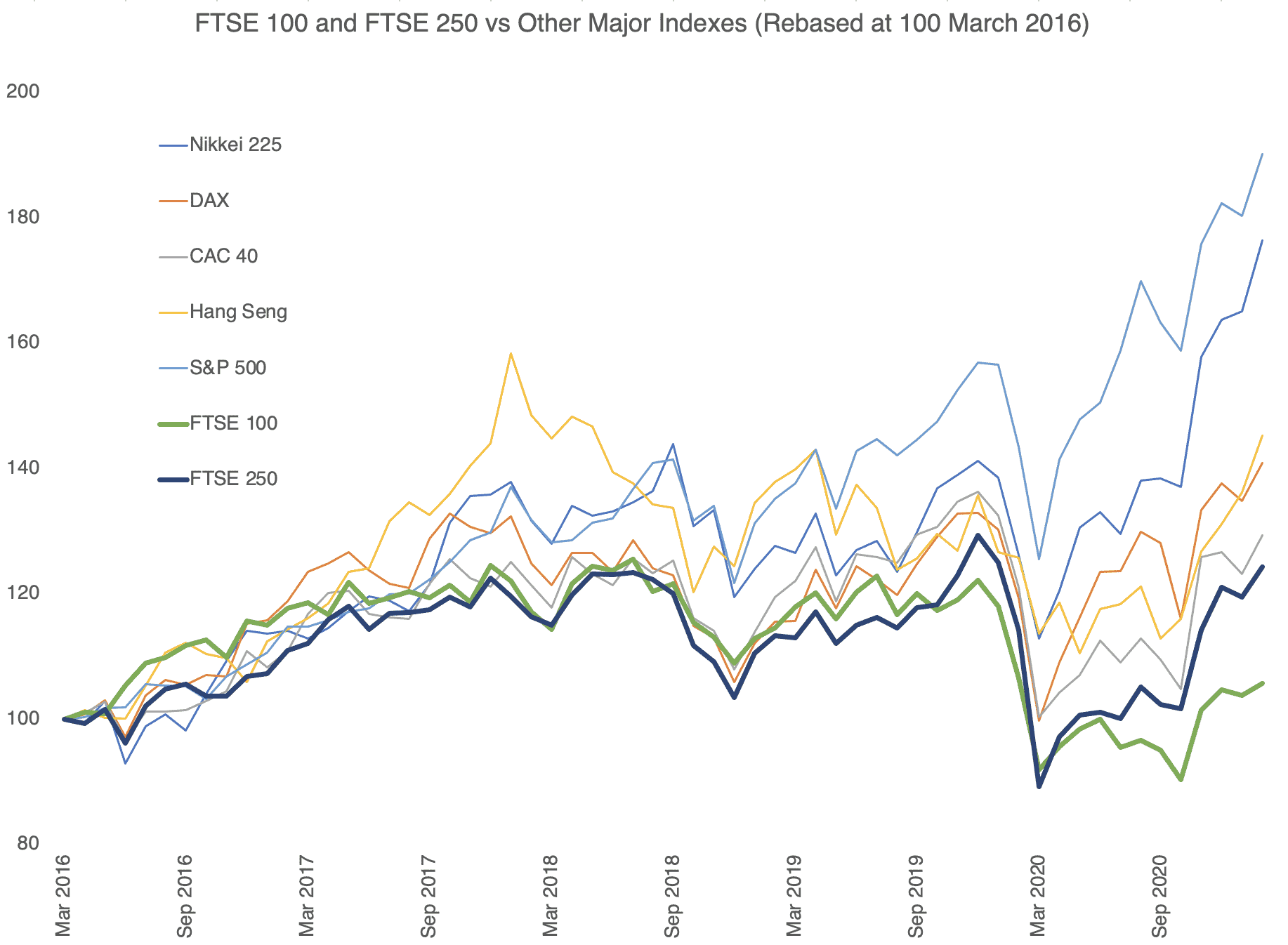
FTSE 100 and 250 compared to there major stock market indexes (rebased at 100 in 2016)

Should you buy Rolls Royce shares today?

Before you decide, please take a moment to review this report first. Despite ongoing uncertainties from US tariffs to global conflicts, Mark Rogers and his team believe many UK shares still trade at substantial discounts, offering savvy investors plenty of potential opportunities to learn about.

That’s why this could be an ideal time to secure this valuable research – Mark’s analysts have scoured the markets to reveal 5 of his favourite long-term ‘Buys’. Please, don’t make any big decisions before seeing them.

Sources: Yahoo Finance and author’s own calculations

The UK has now left the EU with a trade deal. Some details still need to be worked out, particularly for the financial sector, but uncertainty has diminished. The UK is doing an excellent job at vaccinating its population, and a route out of the pandemic is opening up. Yet, the FTSE 100 is below where it was in March 2016. Indexes like the French CAC 40, the German DAX, and the Japanese Nikkei 225 sit higher now than five years ago.

Growth and value

Compared to other indexes, the FTSE 100 looks cheap and potentially primed to recover strongly as the UK transitions back to something approaching normality. And normality is what the FTSE 100 needs. Financial, travel, and oil stocks make up a good chunk of the FTSE 100’s total market capitalisation.

Oil prices collapsed last year, and although they have recovered, climate change concerns still weigh heavily on the share prices of oil majors, like BP and Shell. Financial stocks, like banks and insurers, have been dealing with low-interest rates and squeezed margins for some time. Moreover, insurance claims and default on loans spiked during the crisis, putting pressure on financial stock prices. Travel and tourism collapsed last year, leaving planes grounded and rooms empty, which rocked the prices of airline and hotel stocks.

The S&P 500, compared to the FTSE 100, is dominated by tech and Internet stocks. These saw benefits from people getting more things done online, and people could no longer freely meet or move around. The CAC 40 and the DAX also suffered compared to the US index because they have similar shortcomings as the FTSE 100. Growth stocks have had a wild run since March 2020, taking the S&P 500 to new heights. Value stocks, on the other hand, have suffered and acted like anchors on the price of the CAC 40, DAX, and in particular the FTSE 100.

Cheap British stocks

UK stocks certainly look cheap when compared to other indexes. The FTSE 100 appears to have been trading at a discount to other major indexes since the middle of 2017. The FTSE 250 started underperforming on a relative basis before its larger counterpart, reflecting its greater exposure to a potentially messy Brexit. FTSE 250 companies derive a larger share of their revenue domestically, and a no-deal Brexit would have hit them harder. For the FTSE 250, a positive Brexit result should be positive, as would the UK coming out of lockdown permanently. FTSE 100 companies tend to get the bulk of their revenues internationally. An end to the global pandemic should be a boon for these stocks.

What the UK markets need is a shift away from growth stocks and towards value ones. This will require a change in sentiment, which in turn requires the world economy to heat up.


James J. McCombie owns shares of BP. The Motley Fool UK has no position in any of the shares mentioned. Views expressed on the companies mentioned in this article are those of the writer and therefore may differ from the official recommendations we make in our subscription services such as Share Advisor, Hidden Winners and Pro. Here at The Motley Fool we believe that considering a diverse range of insights makes us better investors.

More on Investing Articles

DIVIDEND YIELD text written on a notebook with chart
Investing Articles

I’m targeting a yearly income of £6,898 from £20,000 in this FTSE heavyweight!

This FTSE dividend play looks far too cheap for the cash it throws off — and the mix of rising…

Read more »

Passive income text with pin graph chart on business table
Investing Articles

How much would I need to invest in this FTSE 100 dividend gem to aim for £14,754 a year in passive income?

Passive income is the goal for many investors, and this FTSE dividend star highlights the qualities that can turn long‑term…

Read more »

View over Old Man Of Storr, Isle Of Skye, Scotland
Investing Articles

How much do you need in a SIPP to earn a £667 monthly passive income?

Harvey Jones shows how investors could use the generous tax breaks available on a Self-Invested Personal Pension, or SIPP, to…

Read more »

Happy male couple looking at a laptop screen together
Investing Articles

Up 50% with a stunning 6.4% yield! How do Aviva shares do it?

Harvey Jones is hugely impressed by the recent performance of Aviva shares, and examines why the FTSE 100 insurer has…

Read more »

Satellite on planet background
Investing Articles

Down 19% to under £20! Is now exactly the right time for me to capitalise on BAE Systems’ bargain-basement share price?

BAE Systems’ share price has dropped sharply, but a far bigger long term demand cycle is only just beginning. Here’s…

Read more »

Person holding magnifying glass over important document, reading the small print
Investing Articles

Closing in on £33 and around an all‑time high, is this FTSE 250 favourite seriously mispriced?

With the shares pushing into record territory, I’ve revisited the underlying business, its growth outlook and the valuation picture investors…

Read more »

Close-up of British bank notes
Investing Articles

£20,000 invested in Barclays shares a year ago is now worth…

Barclays shares have quietly delivered a 41% return in just 12 months — and the long term numbers suggest the…

Read more »

Young black woman walking in Central London for shopping
Investing Articles

£9,000 in an ISA? Here’s how to target a £675 passive income with 7% investment trusts

Investment trusts can offer a huge and stable passive income every year. Royston Wild reveals three to consider -- including…

Read more »